
General Safety & Medical Disclaimer
The information provided in this article is intended for general educational purposes only and does not constitute professional veterinary medical advice, diagnosis, or treatment. Every dog is an individual, and cold weather tolerance varies based on age, health status, coat type, body composition, and acclimatization history. Always consult a licensed veterinarian before making decisions regarding your pet’s health, outdoor exposure, or seasonal care routine. If your terrier shows signs of hypothermia or frostbite, seek emergency veterinary care immediately.
By Sandy, Founder of Jet Set Paw
The frost had barely lifted off the grass when Catch-him hit the yard at full speed, nose down, tail up, utterly unbothered by the January chill rolling in off the hills.
He is built for this — a German Shepherd engineered by centuries of outdoor work, wrapped in a dense double coat that laughs at cold mornings.
Nick, my tricolor companion, was a different story. She stepped off the porch, paused, and looked back at me with an expression that asked, very clearly, whether this had been thoroughly thought through.
That moment — two dogs, same yard, same temperature, two completely different realities — is exactly where the question begins. Are terriers not a winter dog?
It is not a question I can answer with a single yes or no, and honestly, I do not think any responsible pet owner should accept one. What I can tell you is that it is the right question to be asking, and that far too many terrier owners are not asking it at all.
Here is the tension at the heart of living with a similar terrier in winter: these are dogs wired for boldness. Fearless, driven, comically convinced of their own invincibility.
But that outsized personality is housed in a small, often lightly insulated frame that loses body heat faster than most owners realize. Do terriers get cold easily? The honest answer depends on breed, coat type, body condition, and age — and the details matter enormously.
In this guide, we are going to work through all of it together: the biology behind cold tolerance, the warning signs you cannot afford to miss, the gear that actually helps, and what a real winter morning with a terrier looks like when you get it right — and when you do not.
Jet Set Paw: The Quick Verdict
Are Terriers Winter Dogs? Here Is the Short Answer.
- Cold tolerance: Low to Moderate — Most terrier varieties, particularly smooth and single-coated breeds, have significantly less natural insulation than large or double-coated breeds and feel cold sooner than their energy levels suggest.
- Breed and coat type change everything — A dense wire-coated Scottish Terrier handles cold far better than a smooth-coated Jack Russell or a fine-coated Yorkshire Terrier. There is no single terrier answer.
- The temperature threshold to know — Most small, smooth-coated terriers should not remain outdoors for extended periods once temperatures drop below 45°F / 7°C, especially with wind chill factored in.
- Activity level is not a safety signal — A terrier still running and playing in the cold is not necessarily a comfortable one. High prey drive and bold temperament can mask early cold stress cues.
- Protection is non-negotiable for small varieties — Fitted winter coats and paw protection are functional necessities for lightweight terrier builds in cold climates, not optional accessories.
Keep reading for the full biological breakdown, breed-by-breed cold guide, gear recommendations, and Sandy’s real-world winter protocol.
Understanding Why Terriers Feel the Cold Differently Than Larger Breeds
Watch Catch-him move through a cold morning, and you are watching physics work in a dog’s favor. A German Shepherd’s dense double coat — a weather-resistant outer layer over a thick insulating undercoat — functions as a biological thermal barrier, trapping warm air close to the body and shedding moisture before it can penetrate to the skin.
His body mass is substantial, his subcutaneous fat layer is present, and his surface-area-to-body-mass ratio is low enough that heat loss to the surrounding air is slow and manageable. He is, in thermodynamic terms, well-matched to the cold.
A small terrier is working with an entirely different set of numbers.
The core vulnerability comes down to three intersecting physiological realities. First, smaller dogs have a disproportionately high surface-area-to-body-mass ratio — meaning they expose more skin surface relative to the body volume, generating heat.
Cold air pulls warmth away faster than a small frame can replace it. Second, most terrier varieties carry minimal subcutaneous fat, which in larger or northern breeds provides a meaningful secondary layer of thermal insulation.
Terriers are lean, muscular dogs bred for agility and speed in burrows and fields — not for cold endurance. Third, coat structure varies dramatically across the terrier group and critically determines how much protection any individual dog actually has.
This is where the question Can terriers live in cold weather demands a more specific answer than most owners receive. Wire-coated varieties — the Welsh Terrier, Wire Fox Terrier, Border Terrier — possess a coarser, denser outer layer that offers better wind and moisture resistance than their smooth-coated relatives.
A Miniature Bull Terrier or smooth Fox Terrier, by contrast, has a short, flat coat with almost no insulating air pocket — functionally closer to wearing a thin cotton shirt outdoors than a proper winter layer. A dog’s individual body condition score (BCS), age, and acclimatization history further shift that threshold in either direction.
The table below provides a working reference — but treat it as a starting point, not a fixed rule.
| Terrier Variety | Coat Type | Cold Tolerance Level | Recommended Minimum Outdoor Temp |
|---|---|---|---|
| Jack Russell Terrier | Smooth / Broken | Low – Moderate | 45°F / 7°C |
| Scottish Terrier | Dense Wiry Double | Moderate | 35°F / 2°C |
| Yorkshire Terrier | Fine Single Layer | Very Low | 50°F / 10°C |
| Welsh Terrier | Dense Wiry Double | Moderate – High | 32°F / 0°C |
| Miniature Bull Terrier | Smooth Short | Very Low | 50°F / 10°C |
| Border Terrier | Dense Wiry Double | Moderate | 35°F / 2°C |
| Rat Terrier | Smooth Short | Low | 45°F / 7°C |
Values represent general guidelines only. Individual health status, age, acclimatization history, and wind chill must always be factored. Consult a licensed veterinarian for breed-specific cold exposure thresholds.
Rat Terriers sit in the same “Low” tolerance band as the Miniature Bull Terrier in terms of coat structure (smooth, short, minimal insulating capacity), but I placed them at 45°F / 7°C rather than 50°F / 10°C since Rat Terriers tend to carry slightly more lean muscle mass and a marginally higher baseline activity-driven heat output than the Mini Bull Terrier — this also keeps the table consistent with the Section 6 narrative, where Nick was already showing cold-stress signs by the 12–13 minute mark in conditions implied to be right around that threshold.
Jack Russell Terriers in Winter — A Closer Look at the Breed Most Owners Get Wrong
If there is one breed that convinces owners it is fine when it is not, it is the Jack Russell Terrier. Proper Jack Russell terrier winter care begins with understanding a fundamental mismatch: this is a dog with the confidence and stamina of an animal twice its size, packaged inside a frame with almost no thermal protection.
That combination is precisely what makes the JRT the breed most likely to be underestimated in cold weather — not because owners do not care, but because the dog refuses to look like it is struggling until it genuinely is.
The coat question matters here, and it is worth being precise. Jack Russells come in two primary coat variants — smooth and broken. The smooth coat is short, flat, and offers negligible insulating capacity.
The broken coat has a slightly rougher, mixed texture but contains no true dense undercoat layer. Neither variant provides meaningful thermal protection once temperatures drop below 45°F / 7°C during sustained outdoor exposure.
What owners often interpret as cold-weather hardiness in their JRT is not insulation at work — it is behavioral masking at work.
The underlying physiology explains why this matters urgently. Every dog has a thermoneutral zone — the ambient temperature range within which the body maintains core temperature without redirecting metabolic resources.
When a small terrier moves below that zone, the body begins shunting energy away from muscle activity and immune function toward thermogenesis: the physiological process of generating heat to protect core organ temperature.
The dog may still appear to be moving normally, but internally, metabolic priorities have shifted. Repeated cold exposure under these conditions progressively suppresses immune response, accelerates muscular fatigue, and in vulnerable individuals — young puppies, seniors, dogs with subclinical illness — can precipitate clinical hypothermia in as little as 30 minutes.
How the JRT’s Hunting Drive Can Override Cold Distress Signals
The Jack Russell Terrier was purpose-bred as an earth dog — specifically to pursue foxes into underground burrows, a task demanding explosive drive, pain tolerance, and absolute focus under pressure. That heritage has a direct winter safety implication.
When a JRT locks onto a scent trail or enters prey-pursuit mode, the sympathetic nervous system generates a sustained arousal state that functionally suppresses the behavioral signals owners rely on to assess comfort: shivering, postural hunching, slowed movement, and reluctance to continue.
The dog is not performing. It is neurologically engaged in a way that genuinely overrides early cold-distress cues. This means that for Jack Russells specifically, owner-observed behavior is an unreliable sole indicator of cold safety.
Time outdoors, ambient temperature, and wind chill must govern the decision — not whether the dog still looks like it wants to keep running.
Reading Your Terrier — The Clinical and Behavioral Signs a Dog Is Too Cold Outside
Cold stress in terriers does not always announce itself dramatically. That is the first thing every owner needs to understand — and arguably the most dangerous assumption to get wrong.
The signs a dog is too cold outside exist on a clinical progression, and by the time the most obvious ones appear, the situation has already moved past early intervention territory.
Learning to read the full spectrum, from subtle to severe, is what separates a close call from a genuine emergency.
The earliest signs are easy to dismiss. Piloerection — the involuntary raising of hair along the dorsal line from neck to tail — is the body’s first attempt to trap a layer of insulating air close to the skin.
In short-coated terriers, it may be barely visible, which is exactly why owners miss it. Shivering follows: this is not comfort-seeking behavior; it is skeletal muscle thermogenesis — the body triggering rapid, involuntary muscle contractions to generate heat when core temperature begins to fall.
Alongside shivering, watch for behavioral shifts: a reluctance to keep walking, tail tucking low against the abdomen, postural hunching with a rounded back and lowered head, and a dog that keeps trying to turn back toward home or lift its paws off cold ground.
If exposure continues past these early signals, the clinical picture darkens. Slowed mentation — a dog that seems dull, confused, or unresponsive to commands it knows well — signals that the central nervous system is being affected by dropping core temperature.
Muscle rigidity replaces shivering as thermogenesis fails. Pale or blue-tinged mucous membranes, visible on the gums, indicate cyanosis — compromised peripheral circulation as the cardiovascular system prioritizes core organ perfusion over the extremities.
Collapsed posture is a late-stage sign requiring immediate emergency veterinary intervention.
Frostbite vs. Cold Stress — Knowing Which Emergency You’re Facing
While the body is managing core temperature, the extremities are quietly at risk. Frostbite in dogs targets the areas with the least circulatory protection: ear tips, toe pads, and tail tips.
It presents initially as skin that appears pale, gray, or blue-white — tissue from which circulation has been withdrawn. Upon rewarming, the affected area becomes red, swollen, and painful as blood flow returns and the inflammatory response begins.
This rewarming must never be accelerated with direct heat sources such as heating pads, hair dryers, or hot water, as rapid temperature change causes additional vascular damage to already compromised tissue.
The triage distinction is critical: cold stress — a dog that is shivering, hunched, and uncomfortable but alert — is managed with immediate removal from the cold, passive warming with blankets, and close monitoring.
Frostbite is a tissue injury requiring veterinary assessment to determine the extent of cellular damage and potential necrosis. When in doubt about which situation you are facing, contact your veterinarian immediately.
Dressing the Part — Do Small Terriers Need Winter Coats, and What Actually Works
Do small terriers need winter coats? For smooth-coated and single-coated varieties, the answer is not a matter of preference — it is a matter of physiology.
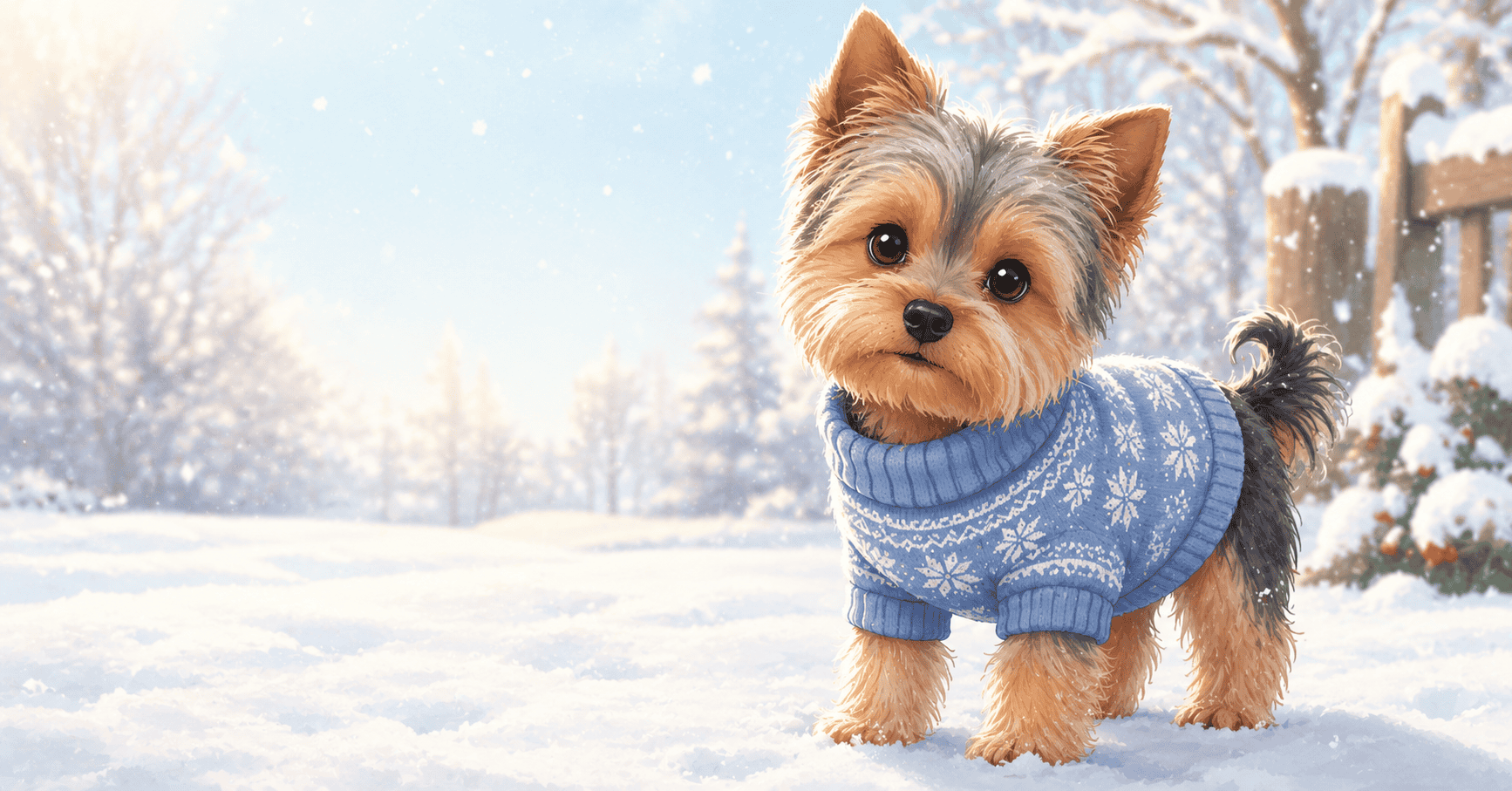
A well-fitted dog coat on a Jack Russell, Yorkshire Terrier, or Miniature Bull Terrier is not a fashion statement.
It is a functional thermoregulatory intervention that compensates directly for what the breed’s anatomy cannot provide: an insulating layer between the dog’s skin and the cold air stripping heat away from it.
Owners who resist coats on the grounds that they seem unnecessary or undignified are, in practical terms, asking their dog’s metabolism to work harder in the cold to make up the difference.
Not all dog coats are equal, and fit criteria matter significantly. An effective winter coat for a terrier must cover from the base of the neck to the base of the tail — partial coverage leaves the critical thoracic and abdominal regions exposed.
A chest and belly panel is non-negotiable for small breeds, as the underside of the body loses heat rapidly to cold ground air and is entirely unprotected by a coat that only drapes over the back.
Shell material should be either water-resistant to repel wet snow and sleet or fleece-lined for dry cold conditions.
Fit must be snug without restricting the terrier’s natural range of motion — a coat that bunches at the shoulders or pulls across the chest will be actively resisted, and a terrier that resists its coat will find a way out of it.
Winter dog booties for small breeds address a separate but equally serious vulnerability. The toe pads contain dense concentrations of superficial capillary beds that are among the first tissues to lose circulatory protection in the cold, making them disproportionately susceptible to frostbite.
Booties provide both thermal insulation and — critically — a physical barrier against road salt, deicing agents, and ice melt compounds.
Many commercial deicers contain sodium chloride or propylene glycol: both cause significant chemical irritation to paw pad tissue on contact, and both are toxic upon ingestion, which occurs routinely when dogs groom their paws after walks. A bootie eliminates the exposure pathway.
The practical caveat is that booties require acclimation. A terrier fitted with booties for the first time and immediately sent outdoors will spend its walk attempting to remove them.
Gradual introduction using positive reinforcement conditioning — short indoor sessions, reward-paired — produces a dog that tolerates and eventually ignores them.
Paw Care Beyond Booties — Musher’s Wax and Post-Walk Decontamination Protocol
For owners whose terriers will not tolerate booties, or as a complementary layer when they do, musher’s wax or a veterinarian-approved paw balm applied before each walk creates a protective barrier on the pad surface that resists moisture penetration and reduces direct chemical contact.
It is not equivalent to a bootie but meaningfully reduces exposure. Regardless of whether booties are used, every winter walk should end with the same protocol: wipe all four paws thoroughly with a damp cloth before the dog has any opportunity to self-groom.
Chemical deicers do not need prolonged contact to cause harm — removing them immediately after outdoor exposure is the simplest and most consistently effective line of defense available.
A Winter Morning With Nick — When the Cold Became Real
It was a Tuesday in February, early enough that the street was still empty and the pavement had that particular gray stillness that comes before the sun has done anything useful. I had Nick, my Rat Terrier, on her lead and Catch-him loose at my left side, and we had been out maybe twelve minutes when I noticed it.
Not shivering — that is what I want to be clear about, because I think most people are waiting for shivering. What I noticed was smaller than that. Nick’s gait changed.
Not dramatically, not a limp, not a sudden stop. She just became slightly less fluid. The easy, ground-covering trot she defaults to on a normal walk tightened up, shortened.
Her tail, which usually carries itself with a certain authority, dropped an inch or two below its usual position. She was still moving. She was still engaged. But something in the mechanics of how she was moving had shifted, and once you know to look for it, it is impossible to unsee.
Catch-him was twenty feet ahead of us, nose working the frozen grass along someone’s fence line, completely unbothered. His double coat was doing exactly what it was designed to do — holding warm air against his body, shedding the cold away from his skin.
He was, genuinely, comfortable. Nick, at a fraction of his mass with the short, smooth coat typical of a Rat Terrier, was already past the point where her body was managing the temperature effortlessly.
I turned us around at thirteen minutes.
Back inside, Nick went directly to her spot near the radiator — not dramatically, not urgently, just deliberately — and curled into a tight circle in the way dogs do when they are reclaiming warmth they have spent.
Within ten minutes, she had fully relaxed. No lasting effect. But the moment stayed with me because of how quiet it had been. No drama. No obvious distress signal. Just a subtle shift in movement that I nearly walked past.
That morning recalibrated how I think about winter walks entirely. The cold does not announce itself in terriers the way it does in dogs that vocalize discomfort or simply refuse to go further.
It shows up in small mechanical details — and you have to already know what normal looks like to recognize when something has changed.
Terriers are not fragile dogs. Nick is not fragile. She is specific. She has a specific coat, a specific body mass, a specific thermal threshold — and staying on the right side of that threshold is not coddling her. It is knowing her. That distinction is the whole point of everything in this guide.
The Sandy-Proof Cold Weather Checklist — What Terrier Owners Must Do Before, During, and After Every Winter Outing
Everything covered in this guide comes down to one practical truth: preparation is the entire game in cold-weather terrier care. Use this checklist every time the temperature drops and the lead comes out.
Before the Walk
- Ambient temperature and wind chill checked against your terrier’s breed-specific threshold
- Belly-coverage winter coat fitted for smooth or single-coated varieties below 45°F / 7°C
- Musher’s wax or veterinarian-approved paw balm applied to all four pads
- Winter booties fitted and secured if pavement deicers are present
- Baseline health assessed — sick, elderly, or post-surgical terriers outdoors for bathroom breaks only
During the Walk
- Outdoor duration capped at 15–20 minutes for small terriers below 40°F / 4°C
- Continuous monitoring for shivering, tucked tail, slowed gait, or reluctance to continue
- Metal surfaces, frozen water, and heavily salted pavement are actively avoided
- Terrier kept moving — stationary cold exposure accelerates heat loss significantly
- No terrier left unattended in a cold car or outdoor kennel under any circumstances
After the Walk
- All four paws were wiped immediately with a damp cloth to remove deicing chemicals and road salt
- Ear tips, toe pads, and tail tip checked for pallor, grayness, or ice accumulation
- Fresh water offered — cold exposure increases dehydration risk even when thirst is not apparent
- A ten-to fifteen-minute indoor warm-up period is observed before returning to normal activity
- Veterinarian contacted immediately if any signs of hypothermia or frostbite are present
Cold weather and terriers can absolutely coexist — it just requires knowing your dog well enough to meet their specific needs, not the needs of the dog you assumed you were getting.