
Disclaimer: This article is for informational purposes only and does not substitute for professional veterinary diagnosis or treatment. Always consult a licensed veterinarian before introducing any new food into your dog’s diet, particularly if your dog has a pre-existing health condition such as kidney disease, diabetes, or a sensitive digestive system.
By Sandy, Founder of Jet Set Paw
Every July, my backyard turns into a watermelon war zone. I’ll be slicing up a melon for myself, and within seconds, I’ve got two very different sets of eyes locked onto my cutting board.
So yes, can dogs eat watermelon? I get asked this constantly, and after years of feeding two very different dogs, I’ve learned the answer is more nuanced than a simple yes or no.
My adventurous German Shepherd, Catch-him, treats watermelon rind like a personal challenge. He’s lunged off the patio chair more than once, convinced that tough green husk is fair game.
Meanwhile, my tricolor Rat Terrier, Nick, is the polar opposite. He’ll sniff a cube of watermelon flesh suspiciously, take one cautious lick, and decide whether it’s worth his time.
Same fruit, same household, two completely different risk profiles, especially when you factor in Nick’s much smaller frame.
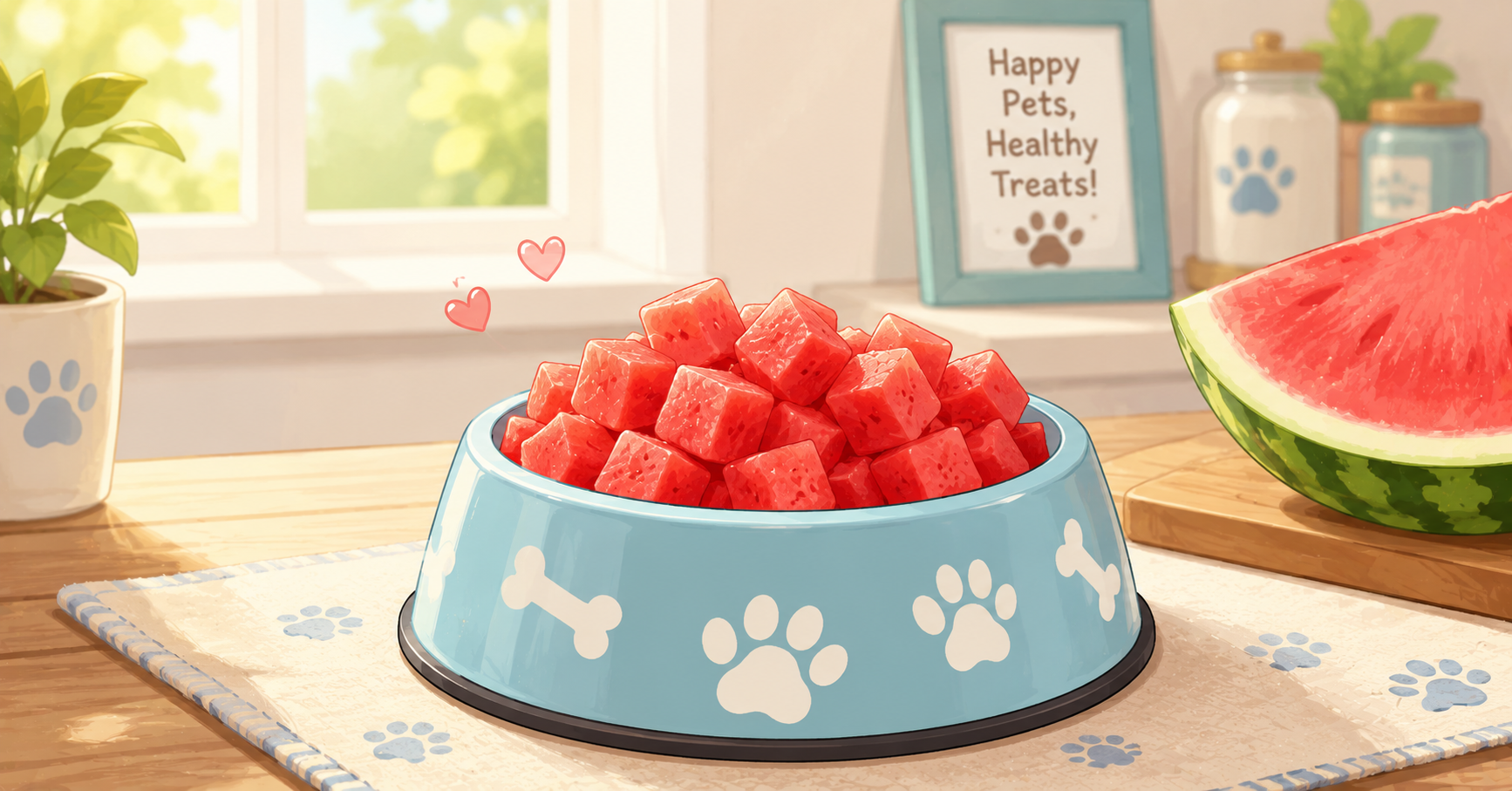
That contrast is exactly why this topic matters. Watermelon flesh, when seedless and properly portioned, can actually be a refreshing, hydrating treat for most healthy dogs.
But the rind and seeds tell a very different story, and dogs with kidney concerns need an entirely separate conversation.
Below, I’m breaking down exactly what’s safe, what’s risky, and how to know which category your dog falls into.
Jet Set Paw: The Quick Verdict
- Safe form: Seedless, fresh watermelon flesh, cut into small cubes
- Danger zone: Rind and seeds — both pose choking and intestinal obstruction risks
- Portion cue: Treat-level only, roughly 1–2 cubes per 10 lbs of body weight, occasionally
- Vet-flag symptom: Vomiting, bloating, or no bowel movement within 24 hours of ingestion warrants an immediate call to your vet
The Verdict in Detail — What Counts as Safe Watermelon for Dogs
The quick answer deserves a fuller explanation, because “safe” only applies under specific conditions. Dogs can eat watermelon, but the gold standard for safety is always seedless flesh, served fresh or frozen, never the rind, and never the seeds in any meaningful quantity.
When owners ask if dogs can have seedless watermelon, the answer is an enthusiastic yes. This is the version I hand to both Catch-him and Nick every summer, and it’s the only version I’d recommend without hesitation.
Seedless watermelon eliminates the choking and obstruction risk that whole seeds carry, while still delivering the hydration and light vitamin content that make this fruit appealing as a treat.
That said, “seedless” commercial watermelon can still contain small, soft white seed remnants, so a quick visual check before serving is always worth the ten seconds it takes.
Portion size, though, is where most owners go wrong, treating watermelon like a meal topper rather than an occasional treat.
The table below breaks this down by weight class, since a serving appropriate for a German Shepherd like Catch-him would overwhelm a Rat Terrier like Nick.
| Dog Size (Weight) | Recommended Serving | Frequency | Best Form |
|---|---|---|---|
| Small (under 20 lbs) | 1–2 small cubes | 1–2x per week | Cubed, well-chilled |
| Medium (20–50 lbs) | 3–5 cubes | 2–3x per week | Cubed or pureed |
| Large (50+ lbs) | 5–8 cubes | 2–3x per week | Cubed or frozen |
This table answers the most common question I receive: how much watermelon can a dog eat without tipping into digestive trouble? Treat these numbers as a ceiling, not a daily target, and always introduce watermelon gradually the first time.
Why Watermelon Works — The Biological Case for This Hydrating Fruit
To understand why watermelon fits into a dog’s diet at all, it helps to clear up a common misconception. Dogs are not obligate carnivores; that classification belongs to cats, whose bodies require nutrients found almost exclusively in animal tissue.
Dogs are facultative carnivores, sometimes described as omnivorous scavengers, meaning their digestive systems are biologically equipped to process and extract value from plant matter, including fruit.
This is precisely why watermelon doesn’t sit in a dog’s gut as foreign material the way it would for a strict carnivore.
Watermelon’s biggest contribution is hydration. At roughly 92% water content, a few chilled cubes on a hot afternoon do real physiological work, supplementing fluid intake in dogs who are reluctant water drinkers or who’ve spent the day outside, as Catch-him often has after an hour of backyard zoomies.
Beyond water, watermelon supplies vitamin A, which supports skin and coat health, vitamin C, an antioxidant that, while dogs synthesize their own, still offers supplemental benefit, and potassium, an electrolyte involved in muscle and nerve function.
This nutritional profile is genuinely useful, but it’s worth being precise about what watermelon is and isn’t. It’s a hydrating, vitamin-supportive treat, not a dietary staple, and not a replacement for a dog’s formulated, complete nutrition.
The same fruit that delivers these benefits also carries natural sugars in the form of fructose and a moderate fiber load, both of which become problematic in excess.
This is the biological tension at the heart of the next section: a food that’s genuinely good for dogs in small amounts can become genuinely disruptive once portion control disappears, which is exactly why the serving table in the previous section isn’t a suggestion; it’s a safeguard.
The Hidden Dangers — Rind, Seeds, and the Choking-to-Obstruction Pipeline
If the previous section made the case for watermelon flesh, this one draws a hard line around everything else.
The honest answer to Can dogs eat watermelon seeds and rind is no, and that answer doesn’t soften with smaller amounts or supervised nibbling. These two parts of the fruit operate by an entirely different set of risks than the flesh does.
Rind is the more serious offender. Its tough, fibrous structure is built from dense cellulose, the same indigestible plant material that gives the outer husk its rigidity.
Dogs lack the enzymes to break this material down, which means a swallowed chunk of rind doesn’t digest; it travels.
In the small intestine, where the passage narrows, a piece of rind large enough can lodge in place and cause a partial or complete intestinal obstruction, a condition that frequently requires emergency surgery to resolve.
This is exactly the scenario I watch for with Catch-him, whose enthusiasm for stolen rind chunks has earned him a permanent seat away from the cutting board during prep time.
Seeds present a different mechanical hazard. Whole watermelon seeds are smooth, hard, and an awkward shape to swallow cleanly, making them a genuine choking risk, particularly in small-breed dogs with narrower airways and esophagi, like Nick.
In larger quantities, seeds can also clump and contribute to blockage, though the risk scales with both seed volume and dog size.
It’s worth distinguishing severity here for accuracy: a dog who accidentally swallows one or two seeds while eating flesh is unlikely to face the same outcome as a dog who consumes a large rind chunk.
But “unlikely” is not “safe,” and rind, regardless of quantity, should never be treated as an acceptable risk.
When Watermelon Becomes a Problem — Digestive Fallout and Sugar Considerations
Even when rind and seeds are entirely out of the picture, watermelon flesh itself can cause trouble if the portion guidelines from earlier get ignored. The question can watermelon cause diarrhea in dogs comes up often, and the answer is yes, particularly when a dog overindulges beyond what their digestive system is prepared to process.
The mechanism here is largely osmotic. Watermelon’s high water and natural sugar content, combined with its moderate fiber load, can pull additional water into the intestines when consumed in excess.
This disrupts normal stool consistency and can also shift the balance of gut flora, the bacterial population responsible for healthy digestion.
The result is often loose stool, gas, or mild abdominal discomfort, typically resolving within a day once the fruit clears the system.
I learned this firsthand the summer Catch-him helped himself to a forgotten bowl of cubed watermelon on the counter, several servings beyond what his frame could comfortably handle, and the cleanup that followed was a lesson in respecting portion limits.
Sugar content deserves its own callout, particularly for diabetic dogs. Watermelon’s natural sugar exists primarily as fructose, and while it’s far less concentrated than what’s found in processed treats, it still raises blood glucose levels.
For dogs managing diabetes, even fruit-based sugar spikes can complicate insulin regulation, making watermelon a fruit that requires explicit veterinary clearance rather than casual inclusion.
This is precisely why the serving table in Section 2 isn’t an arbitrary suggestion. Staying within those size-based portions keeps both the osmotic and sugar-related risks manageable, while overshooting them, even with “safe” seedless flesh, is what actually leads to the digestive fallout owners want to avoid.
Special Case — Watermelon and Kidney Health
Few questions require as much precision as is watermelon good for dogs with kidney failure, because the answer depends entirely on the stage and management plan of the disease, not on a blanket yes or no.
On the one hand, watermelon’s high water content and low-protein profile sound appealing for renal support, since kidney disease management often emphasizes hydration and reduced protein load. But the complicating factor is potassium.
Watermelon contains a meaningful amount of this electrolyte, and dogs in later stages of kidney failure often struggle to filter potassium properly, leading to hyperkalemia, a buildup that can affect heart rhythm and muscle function.
What reads as a “kidney-friendly” fruit on the surface can actually work against a renal diet’s carefully calculated electrolyte balance.
It’s also worth correcting a common owner misconception here for accuracy. Many pet parents avoid fruits and vegetables broadly out of concern for calcium oxalate crystals, the compounds responsible for certain kidney stone formations and found in foods like spinach or rhubarb.
Watermelon does not contain significant calcium oxalate content, so that particular risk doesn’t apply here.
The actual concern with watermelon and renal disease is the potassium and fluid load, not stone-forming compounds, and conflating the two leads to either unnecessary fear or, worse, false reassurance.
This is precisely why I never make a unilateral call on this for my own dogs. If either Catch-him or Nick were ever diagnosed with renal disease, watermelon would be a conversation with our veterinarian, not a decision made from an article.
Kidney disease management is highly individualized, often involving bloodwork-guided electrolyte tracking, and any fruit, watermelon included, needs explicit clearance before it touches a renal patient’s bowl.
A Real Summer Afternoon — Lessons from Catch-him and Nick
Last Fourth of July, I hosted a small backyard barbecue, the kind with a folding table sagging under potato salad, a cooler sweating in the shade, and a watermelon sliced into wedges and left, mistakenly, at the edge of the table within nose-reach of two very interested dogs.
Catch-him noticed first. I heard the telltale jingle of his collar tags before I saw him, nose already pressed against a discarded rind on someone’s paper plate.
He’s fast, and he’s bold, the kind of German Shepherd who treats “no” as a suggestion when watermelon is involved. I got there half a second before the rind disappeared, and what struck me afterward wasn’t the near-miss itself, it was how easily it could have gone differently.
One unattended plate, one distracted minute at a barbecue, and I’d have been watching for the obstruction symptoms I now know to flag instead of enjoying the fireworks.
Nick’s moment came later, quieter, and somehow more nerve-wracking. While I was distracted refilling water bowls, he managed to snag a single dropped watermelon seed off the patio stone.
Just one. With Catch-him, a stray seed barely registers; his frame absorbs it without incident. But Nick is a small-breed dog, and one seed in his world carries more weight, mechanically and proportionally, than it would for his housemate.
I watched him closely for the next several hours; no symptoms appeared, and he was fine, but that watchfulness wasn’t optional.
Neither incident ended badly. Both reinforced the same lesson: the rules in this article aren’t theoretical. They’re the difference between a relaxed holiday afternoon and an emergency vet call, and they apply differently depending on the dog standing in front of you.
What To Do If Your Dog Eats Rind or Seeds — Step-by-Step Response
Despite every precaution, accidents happen, and how you respond in the first few hours matters more than panic. Here’s the framework I rely on whenever Catch-him’s curiosity or Nick’s quick reflexes get the better of supervision.
Step one: Assess the quantity. A few accidental seeds swallowed alongside flesh is a different situation than a sizable chunk of rind. Try to estimate what was actually consumed, since this shapes how closely you’ll need to watch your dog over the coming hours.
Step two: Begin a focused observation window. For minor incidents, such as one or two seeds, the next 12 to 24 hours matter most. Watch your dog’s behavior, appetite, and bathroom habits closely rather than assuming everything is fine simply because no immediate reaction occurs.
Step three: Know which symptoms escalate the situation immediately. Vomiting, noticeable lethargy, abdominal pain or visible bloating, straining without producing stool, or no bowel movement within 24 hours are all signs that point toward a possible obstruction rather than routine digestive upset. None of these symptoms should be managed by waiting it out.
Step four: Match your response to the severity. Mild, isolated symptoms like one instance of soft stool after seed ingestion can often be monitored at home with access to fresh water.
But any combination of the red-flag symptoms above, especially following rind ingestion, particularly in smaller dogs, warrants a same-day call to your veterinarian or an emergency clinic rather than a wait-and-see approach.
When in doubt, the safer choice is always professional evaluation. A phone call to your vet describing exactly what was eaten, how much, and what symptoms have appeared costs you a few minutes and can spare your dog a far more serious outcome.
The Sandy-Proof Conclusion — Your Watermelon Safety Checklist
Watermelon doesn’t have to be complicated. Keep this checklist handy for every slice you cut this summer:
- Seedless flesh only, fresh or frozen, cubed for easy chewing
- Small dogs: 1–2 cubes; medium dogs: 3–5 cubes; large dogs: 5–8 cubes, a few times per week max
- Rind: never, regardless of dog size or supervision level
- Seeds: avoid entirely, even “a few” carry choking and blockage risk
- Loose stool or gas after watermelon means you’ve overshot the portion, scale back next time
- Kidney disease diagnosis: no watermelon without explicit veterinary clearance first
- Vomiting, bloating, lethargy, or no bowel movement within 24 hours: call your vet immediately, don’t wait
- When unsure about any of the above, your veterinarian’s input always outranks an article, including this one
Whether you’ve got a rind-stealing German Shepherd like Catch-him or a small, seed-sniffing Rat Terrier like Nick, the rules scale to fit your dog, not the other way around.