General Safety & Medical Disclaimer: This article is intended for general informational and educational purposes only and does not constitute veterinary medical advice. Always consult a licensed veterinarian before making dietary changes for your dog. If your dog has ingested a pork bone and is showing signs of distress, contact your veterinarian immediately or call the ASPCA Animal Poison Control Center at 888-426-4435 (available 24 hours a day, 7 days a week; a consultation fee may apply). Do not wait for symptoms to worsen before seeking professional guidance.
By Sandy, Founder of Jet Set Paw
The question of whether dogs can have pork bones sounds simple — until you’re standing in your kitchen holding a leftover pork chop bone while two sets of eyes lock onto it with very different levels of intensity.
My adventurous German Shepherd, Catch-him, is already at full attention, nose working overtime, certain that bone belongs to him. Meanwhile, my tricolor Rat Terrier, Nick, has somehow materialized from three rooms away, vibrating at a frequency only small dogs can achieve.
Same household. Same bone. Two completely different dogs — and as I’d come to understand, two completely different risk profiles.
That moment is exactly what pushed me to go beyond the usual “yes or no” answers scattered across the internet and actually dig into what veterinary science says.
Because the truth about pork bones for dogs is layered in a way most pet care articles don’t fully honor.
Whether we’re talking about a Sunday rib rack leftover, a raw pork neck, or a smoke-dried bone from the pet store shelf, each scenario carries its own set of consequences — and some of those consequences can land your dog in an emergency clinic before you’ve finished doing the dishes.
What I found in my research genuinely changed how I manage snack time for both Catch-him and Nick. It shifted me from guessing to knowing — and that shift is what I want to hand off to you here.
This guide covers the real biology, the documented risks, the specific symptoms to watch for, and the safe alternatives that actually satisfy a dog’s deeply wired need to chew. Let’s get into it.
Jet Set Paw: The Quick Verdict
Need the bottom line before the deep dive? Here it is.
| Bone Type | Verdict | Risk Level |
|---|---|---|
| Cooked pork bones | Never safe | Extreme — thermal denaturation causes sharp longitudinal splintering; laceration risk to mouth, throat, and intestinal lining |
| Raw pork bones | Conditional | Moderate to High — not blanket-approved; parasitic and bacterial pathogen risk requires specific handling protocols |
| Pork rib bones | Not recommended | High — thin cortical walls fracture into dangerous shards regardless of preparation method |
| Smoked / store-bought pork bones | Never safe | Extreme — processing mimics thermal damage; high sodium and preservative load adds further risk |
The nuance behind each of these verdicts matters — and it could save your dog’s life. Keep reading for the full clinical breakdown.
Breaking Down the Bone — What Happens Inside Your Dog’s Body When They Chew Pork
Before we can talk about which pork bones are dangerous and why, we need to spend a moment inside your dog’s body — because the biology here is what makes the stakes real.
Dogs are classified as facultative carnivores, a designation that sits at the center of ongoing veterinary debate. Unlike obligate carnivores — such as cats, who cannot biologically survive without animal-derived nutrients like taurine and arachidonic acid — dogs possess the metabolic flexibility to derive nutrition from both animal and plant sources.
However, their digestive architecture still reflects millions of years of evolutionary pressure toward a meat-and-bone diet. That distinction matters enormously when we’re assessing what their bodies can and cannot safely process.
The canine stomach operates at a gastric pH of approximately 1 to 2 — a highly acidic environment that rivals industrial-grade acid in its ability to break down dense animal proteins and the calcium-phosphorus mineral matrix found in raw bone.
This acidic environment, combined with the mechanical grinding action of the carnassial teeth and the relatively short intestinal transit time compared to herbivores, means a dog’s gut is genuinely equipped to handle raw bone material under the right conditions.
The critical variable, however, is whether that bone has been cooked. Raw bone retains its periosteum — the fibrous connective tissue layer surrounding the bone — along with an intact collagen scaffolding that gives it pliability under pressure.
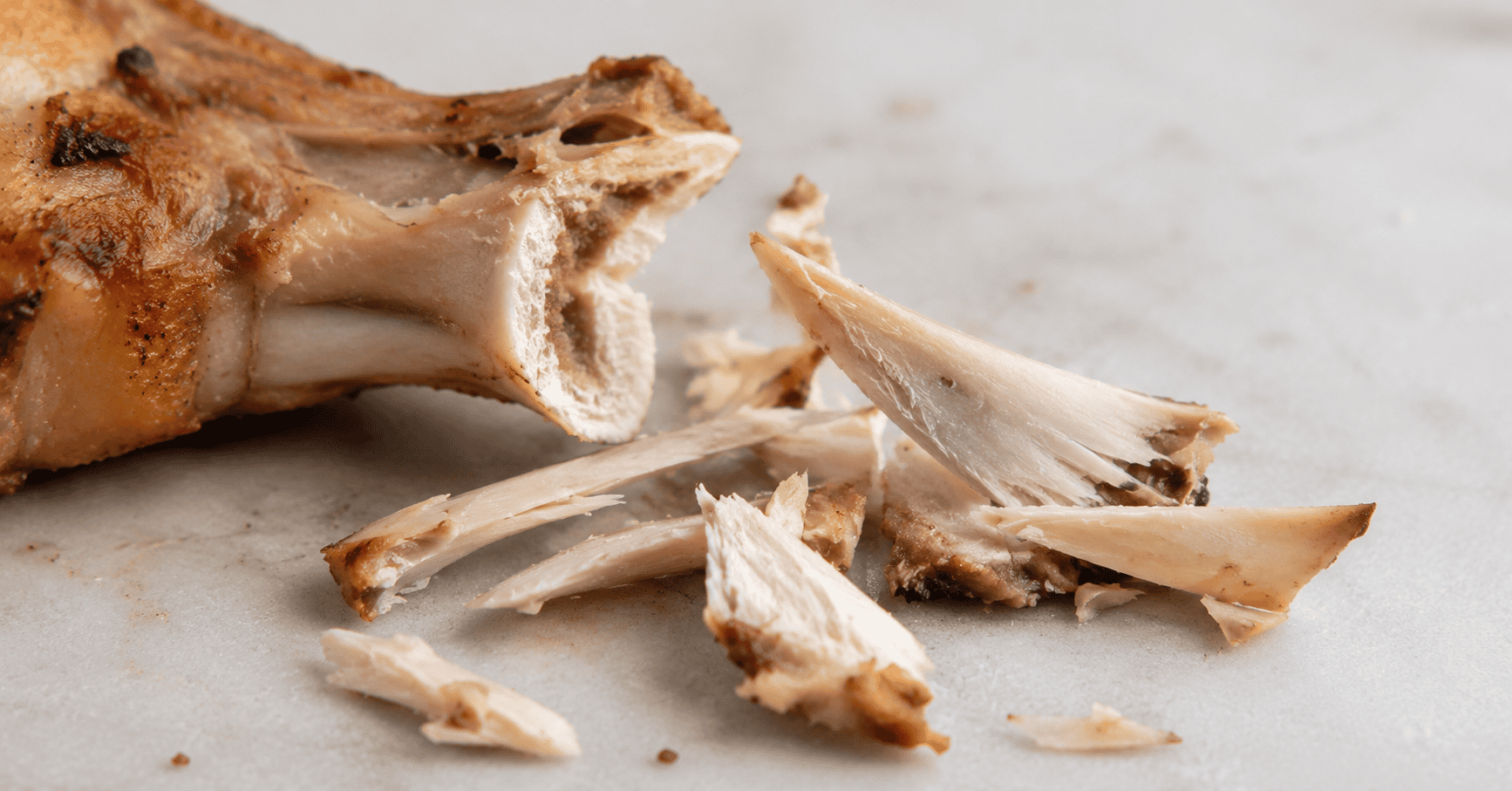
Cooked bone undergoes a fundamentally different structural fate. Thermal processing triggers the Maillard reaction in the bone’s connective tissue, denaturing collagen proteins and driving out moisture.
The result is a brittle, mechanically compromised matrix that fractures under chewing force not into blunt chunks, but into razor-edged longitudinal shards — the precise shape most capable of lacerating soft tissue.
That single distinction — raw versus cooked — is the biological foundation everything else in this article builds on.
The structural consequences of bone fracture under chewing pressure are not limited to the gastrointestinal tract. Pork bones — particularly cooked ones — generate unpredictable fracture patterns under bite force that place the dog’s own dentition at acute risk.
When a dog bites down on a rigid, thermally denatured bone, the force is distributed not only into the bone but back into the tooth itself.
The result can be a slab fracture of the carnassial tooth (upper fourth premolar) or a vertical crown fracture of the canine teeth — injuries that expose the pulp cavity, cause significant pain, and frequently require extraction or root canal intervention under general anesthesia.
This risk is not size-dependent: a large dog generates more bite force, which means more energy returned to the tooth on fracture.
Dental trauma from bone chewing is one of the most common — and most preventable — presentations in small animal veterinary practice.
Pork Bone Risk Reference Table
| Bone Type | Cooked or Raw | Splinter Risk | Veterinary Safety Status |
|---|---|---|---|
| Pork Femur | Raw | Low–Moderate | Conditional |
| Pork Rib Bone | Cooked | Extreme | Never Recommended |
| Pork Rib Bone | Raw | Moderate–High | High Caution |
| Pork Vertebrae | Cooked | Extreme | Never Recommended |
| Store-Bought Smoked Pork Bone | Processed | Extreme | Never Recommended |
Cooked, Raw, or Smoked — Why the Preparation Method Is the Real Danger Variable
If the section above established the biology, this is where that biology becomes urgently practical. The single most important factor determining whether a pork bone poses an immediate danger to your dog is not its size, not your dog’s breed, and not how enthusiastically they chew — it is how that bone was prepared before it ever reached the floor.
Can dogs eat cooked pork bones?
The clinical answer is unambiguous: no. Not boiled, not baked, not roasted, not pressure-cooked — not under any circumstances, for any dog, regardless of size or jaw strength.
This prohibition extends without qualification to puppies — whose developing dentition and immature gastrointestinal mucosa create an even higher vulnerability to fracture injury and perforation — and to senior dogs, whose reduced mucosal integrity and slower intestinal motility increase the risk of obstruction and delayed symptomatic presentation.
When pork bone is heated, thermal denaturation disrupts the collagen matrix running through the bone’s osteon structure — the tightly packed cylindrical units that give raw bone its load-bearing resilience.
What remains after cooking is a dehydrated, mechanically weakened matrix that fractures along longitudinal grain lines under chewing pressure, producing cortical shards with acute laceration potential to the oropharynx, esophagus, stomach lining, and intestinal mucosa.
A large dog does not chew cooked bone more safely than a small dog — they simply generate more force behind the same dangerous fracture pattern.
Can dogs eat pork rib bones?
This question warrants its own answer because rib bones carry a compounded anatomical risk.
Even in their raw state, pork ribs feature unusually thin cortical walls, a curved load-bearing structure, and a high concentration of small trabecular fragments in the interior matrix.
When fractured — and they will fracture — rib bones produce a higher volume of small, irregularly shaped shards than denser bones like the femur. Raw pork rib bones are categorized as high-caution; cooked rib bones are categorically off the table.
Can dogs have raw pork bones?
Here is where precision matters most. Raw pork bones are not automatically safe, and the veterinary community does not offer a blanket approval.
Raw pork tissue is a documented vector for a range of zoonotic pathogens — including Trichinella spiralis (parasitic nematode responsible for trichinellosis), Yersinia enterocolitica (gram-negative bacterium associated with acute gastrointestinal infection), Salmonella enterica (a primary cause of bacterial gastroenteritis in both dogs and their human household members), Listeria monocytogenes (capable of causing listeriosis, with elevated risk for immunocompromised dogs), and Escherichia coli O157:H7 (associated with hemorrhagic colitis).
These are not theoretical risks — they are USDA and CDC-documented pathogens present in commercially sourced raw pork.
USDA freezing protocols reduce parasitic load meaningfully, but the timeline varies by cut thickness and fat content, ranging from 3 days at −4°F (−20°C) for lean cuts up to 20 days at −10°F (−23°C) for denser, higher-fat portions — and freezing does not eliminate bacterial contamination risk.
Raw pork bones, if considered at all, require veterinary consultation, sourcing transparency, and strict supervised chewing protocols.
There is one additional risk from raw pork bones that rarely receives the clinical attention it deserves: pancreatitis.
Pork is one of the highest-fat meats in the domestic food supply, and raw pork bones frequently arrive with significant fatty tissue still attached to the periosteum and surrounding muscle.
When a dog ingests this fat — even incidentally while chewing — the pancreas is triggered to release digestive enzymes in volumes it may not be able to manage, particularly in predisposed breeds such as Miniature Schnauzers, Yorkshire Terriers, and Cocker Spaniels.
The result is acute pancreatitis — a painful, potentially life-threatening inflammatory response characterized by vomiting, abdominal pain, anorexia, and lethargy.
Dogs with any history of fat sensitivity, prior pancreatic episodes, or hyperlipidemia should never be given raw pork bones regardless of sourcing protocols.
The Smoked & Store-Bought Bone Trap
The pet store aisle can feel reassuring — packaged, labeled, marketed as “natural.” It isn’t. Commercially smoked and dried pork bones undergo a processing method that produces the same structural outcome as home cooking: thermal denaturation of the collagen matrix, increased brittleness, and a high longitudinal splintering risk identical to oven-roasted bones.
The “natural” label reflects ingredient sourcing, not safety. Compounding the structural risk, most commercially smoked pork bones carry a significant sodium load and are preserved with chemical additives that can trigger hemorrhagic gastroenteritis — characterized by acute bloody vomiting and diarrhea — in dogs with sensitive gastrointestinal systems.
The packaging may say “for dogs.” The biology says otherwise.
This is not a fringe concern raised by cautious bloggers. The U.S. Food and Drug Administration issued a formal Bone Treat Warning specifically targeting commercially sold bone products — including items labeled “Ham Bones,” “Pork Femur Bones,” “Rib Bones,” and “Smoky Knuckle Bones” — after receiving reports of dogs becoming ill or dying after consuming them.
The FDA’s documented adverse outcomes from these products include gastrointestinal obstruction, rectal bleeding, choking, cuts and wounds in the mouth or on the tonsils, vomiting, diarrhea, and death.
When a federal food safety agency issues a named product warning for a pet treat category, that warning belongs in every conversation about those products. The packaging may say “for dogs.” The FDA’s records say otherwise.
Red Flags and Real Consequences — Recognizing Pork Bone Symptoms and What To Do Next
Education is the first layer of protection. Knowing what to do in the minutes and hours after your dog has already eaten a pork bone is the second — and in some cases, it is the one that determines the outcome.
Dog Ate Pork Bone Symptoms — What to Watch For
Symptoms do not always appear immediately, and their timing carries diagnostic meaning. Organizing your observations around a three-phase timeline gives you — and your veterinarian — critical information.
Acute Phase (0–2 Hours): This window reflects events happening at or near the point of ingestion. Watch for pawing at the mouth or face, hypersalivation (excessive drooling beyond the dog’s normal baseline), gagging, and retching without productive vomiting. These signs are strongly indicative of oropharyngeal or esophageal foreign body lodgment — a bone shard physically caught in the throat or upper digestive tract. Do not dismiss repetitive gagging as a passing moment. It is a signal.
Subacute Phase (2–24 Hours): As fragments migrate further into the gastrointestinal tract, the symptom profile deepens. Abdominal guarding — where the dog tenses or recoils when the belly is touched — signals internal irritation or early perforation.
Tympanic distension (a visibly bloated, drum-like abdomen) indicates gas accumulation consistent with obstruction. Melena — dark, tarry, malodorous stool — is a direct marker of upper gastrointestinal bleeding.
Hematemesis, or vomiting blood, indicates active mucosal laceration. Any one of these signs constitutes a veterinary emergency.
Delayed Phase (24–72 Hours) Symptoms appearing beyond the 24-hour mark are frequently the most serious, as they often indicate complications that have had time to develop systemically.
Pronounced lethargy, complete anorexia, a rectal temperature exceeding 103.5°F (39.7°C), and constipation or obstipation with visible straining are consistent with mechanical intestinal obstruction or peritonitis — inflammation of the abdominal cavity secondary to intestinal perforation. At this stage, the situation is critical.
What To Do If Your Dog Eats a Pork Bone
Act with intention, not panic. Follow this protocol in order.
Step 1 — Do not induce vomiting. This is the most common and most dangerous instinct. If bone fragments are lodged in the esophagus, forced regurgitation can drive shards deeper into soft tissue or cause secondary lacerations on the way back up. Never administer hydrogen peroxide or any emetic agent without direct veterinary instruction.
Step 2 — Gather the facts. Identify and record the bone type (rib, femur, vertebrae), preparation method (cooked, raw, smoked), and your best estimate of the quantity consumed. This information directly shapes your veterinarian’s triage decisions.
Step 3 — Contact a professional immediately. Call your veterinarian or the ASPCA Animal Poison Control Center at 888-426-4435. Do not wait for symptoms to appear before making contact — especially if the bone was cooked or came from the rib cage.
Step 4 — Monitor and transport if needed. Keep your dog calm, restrict movement, and watch closely for any symptom from the acute phase list above. If acute signs emerge, transport to an emergency veterinary clinic without delay.
One point cannot be overstated: do not adopt a wait-and-see approach when cooked or rib bones are involved.
Radiographic imaging — standard X-ray or fluoroscopy — is the only reliable method to locate internal bone fragments and assess whether perforation or obstruction has occurred. What you cannot see from the outside can still be causing serious damage within.
Keeping Pork Bones Out of Reach — Prevention Before the Emergency
The most effective intervention is the one that never needs to happen. These practical steps eliminate the opportunity before it becomes a crisis.
- Use dog-proof lids on all waste bins. Discarded pork bones in an unsecured kitchen bin are accessible to most motivated dogs within minutes. A locking or weighted lid is not optional if you cook pork regularly.
- Clear plates and prep surfaces immediately. The highest-risk window is during meal cleanup — a rib bone left on a counter edge or low table is within reach of more dogs than their owners realize. Treat all pork scraps as a hazard the moment the meal ends.
- Educate every person in the household. Children, guests, and well-meaning relatives are among the most common unintentional sources of dangerous bone access. A household rule — no bones from the table, ever — needs to be communicated clearly and consistently.
- Train and reinforce a reliable “leave it” command. A dog with a solid “leave it” response has a behavioral safeguard that works in the kitchen, at the park, and anywhere a discarded bone might appear. This is one of the highest-value safety commands any dog can learn.
- Store raw pork bones securely if purchasing for other purposes. If raw pork bones are kept in the home for stock or broth, store them in a sealed, elevated, inaccessible location — not on a lower refrigerator shelf a curious dog could reach if the door is left open.
Catch-him and Nick Put It to the Test — A Story From Sandy’s Kitchen
It happened on a Sunday. I was pulling a rack of pork ribs off the grill — company was coming, the kitchen smelled incredible, and I was feeling competent in the way you only do right before something goes sideways. One rib slid off the tray and hit the floor before I could process what was happening.
Catch-him had it in his mouth before the sound finished echoing.
Nick, approximately one-fifth his size and approximately equal in audacity, was already positioned at Catch-him’s elbow, calculating his odds.
Here is what struck me in the split second before I intervened: Catch-him looked completely unbothered. Confident, even. And that is exactly the kind of moment that gives dog owners false assurance. He’s a big dog. He chews through everything. He’ll be fine.
I’ve heard that reasoning more times than I can count — and I’ve said versions of it myself. But size and chewing confidence are not protective factors against a cooked bone fragment lodging in the esophagus or perforating the intestinal wall.
A German Shepherd generates more chewing force, which means more pressure applied to an already brittle, thermally compromised bone matrix. More force does not mean safer fractures. It means faster ones.
I got the rib back. Both dogs were unimpressed with my reflexes and deeply unimpressed with me as a person.
But that Sunday afternoon is why my rule now has no footnotes: if it has been near heat, Catch-him and Nick don’t get near it. No exceptions, no judgment calls, no “just this once.”
The stakes are too uneven, and the dogs are too important.
Safe Bone Alternatives for Dogs — What Sandy Actually Gives Catch-him and Nick
Knowing what to remove from the menu is only half the work. The other half is knowing what to put in its place — because the drive to chew is not a bad habit in dogs.
It is a deeply wired biological behavior that supports dental health, jaw muscle conditioning, and mental engagement.
Eliminating it without a thoughtful substitute creates a different set of problems. These are the safe bone alternatives for dogs that have actually earned a place in my home.
For raw meaty bones (RMBs), the guiding principle is size-matching: the bone’s diameter must exceed your dog’s gape width — the maximum opening of the jaw — to prevent whole-bone swallowing and the intestinal obstruction that follows. For Nick, raw chicken necks are the gold standard.
They are structurally pliable, digestible when consumed in appropriate quantities, and scale correctly for a small dog’s jaw mechanics.
For Catch-him, raw beef kneecaps or marrow bones provide the density needed for extended, satisfying chewing without the extreme splintering risk that thinner bones carry. All RMBs should be given under direct supervision and sourced from reputable suppliers with transparent handling practices.
Beyond RMBs, several non-bone alternatives offer documented dental and behavioral benefits. Single-ingredient bully sticks are fully digestible and carry no splintering risk.
Raw dehydrated trachea is a particularly useful option — it is a natural dietary source of chondroitin sulfate, a glycosaminoglycan that supports articular cartilage health, making it functional as well as satisfying.
Himalayan yak milk chews are slow-digesting, low-splintering, and hold up well under determined chewers.
When evaluating any commercial chew or dental treat beyond the options listed above, one objective benchmark deserves your attention: the Veterinary Oral Health Council (VOHC) Seal of Acceptance.
The VOHC is an independent body that reviews clinical trial data submitted by manufacturers and awards its seal only to products that demonstrate a statistically significant reduction in plaque or tartar accumulation.
A VOHC seal does not guarantee a product is perfect for every dog, but it does confirm that an independent scientific review — not just a marketing claim — supports its dental benefit.
When shopping for chews, look for the VOHC seal on the packaging or verify the current approved product list at vohc.org before purchasing.
What deserves equal space here is what to avoid even within the “safe alternative” category. Nylon bones fracture into non-digestible polymer fragments that accumulate in the gastrointestinal tract.
Antlers, despite their natural origin, register an extreme hardness rating that routinely causes slab fracture of the carnassial tooth — the upper fourth premolar, the largest and most functionally critical shearing tooth in the canine dentition.
Corn and wheat-based chew sticks offer negligible nutritional value, carry a high glycemic index, and can aggravate dogs managing inflammatory bowel disease.
There is one way pork bones can contribute something genuinely beneficial to your dog’s diet — and it does not involve chewing them at all.
Unseasoned pork bone broth, prepared by simmering raw pork bones in water for several hours and then removing all bones and bone fragments entirely before serving, delivers collagen peptides, gelatin, and trace minerals in a digestible, low-risk liquid form.
Mixed in small quantities into your dog’s regular food, it adds palatability, supports gut lining integrity, and provides a use for bones that would otherwise be discarded.
Key requirements: no onion, no garlic, no salt, no seasoning of any kind — all common additions to human bone broth recipes that carry toxicity risk for dogs.
And the bones themselves never go into the bowl — only the strained liquid. As always, consult your veterinarian before introducing new food elements, particularly if your dog has a history of gastrointestinal sensitivity or pancreatitis.
Sandy’s Approved Chew Roster for Catch-him and Nick
| Chew Type | Best For |
|---|---|
| Raw chicken necks | Small dogs (Nick) — supervised, size-appropriate |
| Raw beef kneecap/marrow bone | Large dogs (Catch-him) — supervised, density-matched |
| Single-ingredient bully sticks | All sizes — fully digestible, no splinter risk |
| Raw dehydrated trachea | All sizes — joint-supportive, chondroitin sulfate source |
| Himalayan yak milk chews | All sizes — slow-digest, low-splintering, long-lasting |
| Nylon bones | Avoid — non-digestible polymer fragment risk |
| Antlers | Avoid — carnassial tooth slab fracture risk |
| Corn/wheat chew sticks | Avoid — low nutrition, IBD aggravation risk |
The Sandy-Proof Wrap-Up — What Every Dog Parent Should Walk Away Knowing
Here is everything that matters, stripped down to what you can actually use:
- Cooked pork bones — never, no exceptions, no dog size, no circumstance
- Raw pork bones — conditional only, pathogen-aware sourcing, direct supervision required
- Pork rib bones — high cortical fracture risk regardless of preparation method
- Heat changes bone structure permanently — preparation method is the primary danger variable
- Smoked and store-bought pork bones — thermal risk identical to home-cooked; “natural” label means nothing here
- Symptoms after ingestion — immediate veterinary contact, never a wait-and-see call
- Cooked or rib bone ingestion — radiographic imaging is the only reliable internal assessment
- Do not induce vomiting — without direct veterinary instruction
- Size-matched raw meaty bones — the evidence-supported default for safe chewing
- Antlers and nylon bones — off the approved list, regardless of marketing claims
- Sandy’s standing rule — if it touched heat, Catch-him and Nick don’t touch it
At Jet Set Paw, every recommendation we make is the same one I apply to my own dogs first — because Catch-him and Nick deserve the same research-backed care yours do. Stay curious, stay cautious, and when in doubt, call your vet.
— Sandy