
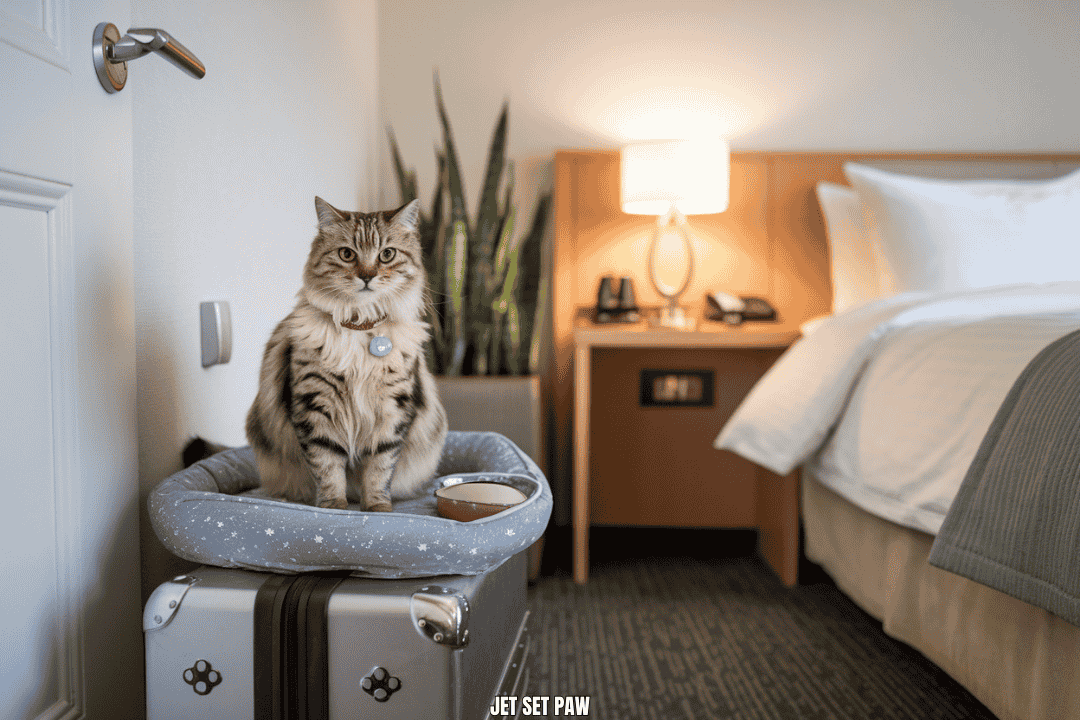
General Safety & Medical Disclaimer
The information in this article is intended for general educational purposes only and does not constitute professional veterinary advice, diagnosis, or treatment. Every cat has unique health needs, behavioral thresholds, and stress responses. Always consult a licensed veterinarian before traveling with your cat, especially if your pet has a pre-existing medical condition, anxiety disorder, or is on medication. Never administer sedatives, calming supplements, or over-the-counter treatments without prior veterinary approval. Hotel pet policies vary widely and are subject to change without notice — always confirm directly with the property before booking.
By Sandy, Founder of Jet Set Paw
The first time I watched a friend’s cat press himself flat against the back wall of a hotel bathroom in Tampa, I understood something important: wanting to travel with a cat and actually knowing how to bring a cat to a hotel safely are two very different things.
I’ve logged thousands of road miles with my own animals. Catch-him, my adventurous German Shepherd, and Nick, my tricolor companion, have always taken new environments in stride — sniffing every corner with enthusiasm, claiming the nearest dog bed like seasoned hotel critics.
Dogs, generally, adapt instinctively. Cats do not. They adapt on preparation — and that distinction has shaped everything I’ve learned helping fellow travelers navigate traveling with a cat and staying in hotels without turning the experience into a stress event for everyone involved, the cat included.
Over the years, between my own road trips with Catch-him and Nick and the countless cat-owning friends and readers I’ve coached through their own hotel stays, I’ve come to understand pet deposits, hidden fees, so-called “pet-friendly” policies that barely tolerate a goldfish, and the very real risks that come with winging it.
I’ve watched the mistakes happen so you don’t have to, and I’ve built a travel system that keeps a cat calm, keeps bookings legitimate, and keeps a hotel willing to welcome pets back.
Whether this is your first hotel stay with a cat or your fifteenth, what follows is the most practical, honest breakdown I can give you — built from real multi-pet travel experience and grounded in what veterinary science actually tells us about feline stress and travel safety.
Let’s start with the fast version.
Jet Set Paw: The Quick Verdict
— Always obtain veterinary clearance and a health certificate before any hotel trip with your cat — it protects your pet and your booking.
— Search specifically for verified cat-friendly hotels, not just “pet-friendly” — the difference in policy, fee structure, and room preparation is significant.
— Begin carrier acclimation at least two to four weeks before departure; a cat that trusts its carrier is a calmer traveler from door to destination.
— Read every hotel pet policy in full and confirm the details by phone — undisclosed cleaning fees and non-refundable deposits are far more common than advertised.
— Set up a dedicated “base camp” corner the moment you arrive: litter box, scent-familiar bedding, open carrier, and a pheromone diffuser running before your cat explores the room.
— Sneaking a cat into a hotel is never a low-risk workaround — it exposes your pet to unmanaged safety hazards, puts other guests at risk, and carries real financial and legal consequences.
— In-room calm is built before arrival, not improvised after — preparation is the only strategy that consistently works.
Before You Book — What “Cat-Friendly” Actually Means
“Pet-friendly” is one of the most overused and under-defined phrases in the hospitality industry. When you search for cat-friendly hotels near me and filter by that label, what populates your results is not a curated list of genuinely feline-prepared accommodations — it is a spectrum.
On one end, you have properties with designated pet relief areas, hard-floored pet rooms, on-call veterinary referral lists, and staff trained in animal-in-room protocols.
On the other end, you have hotels that accept pets simply because their corporate policy has not explicitly banned them, with zero infrastructure to support that decision and a fee structure designed to compensate for the inconvenience.
Nick has stayed in both. The difference is not always visible in the listing.
The word “friendly” implies readiness. In practice, it often just means tolerated — and tolerated comes with conditions buried in fine print that most travelers do not read until they are standing at the front desk with a cat carrier in hand and a surprise charge appearing on their folio.
Understanding the financial architecture of hotel pet policies is not pedantic preparation. It is the single most effective way to avoid a trip that costs twice what you budgeted and delivers half the comfort your cat needs.
Pet Deposit Structures and Hidden Fee Realities
Hotel pet fees generally fall into two categories, and conflating them is a costly mistake. A refundable pet deposit functions like a security hold — it is returned at checkout provided no damage is documented.
A non-refundable pet fee is a flat charge for the privilege of bringing your animal into the room, damage or not. Many hotels charge both simultaneously, and neither is consistently disclosed at the top of a booking page.
Beyond the headline fee, watch for: nightly pet surcharges layered on top of a flat deposit, mandatory housekeeping fees that increase with stay length, room-type restrictions that limit pet guests to smoking-adjacent wings or ground-floor rooms with exterior access only, and weight or size thresholds — policies typically written for dogs that are applied to cats with equal rigidity at many chain properties.
A growing number of mid-range and luxury hotels have also introduced hypoallergenic room blocks — designated floors or wings maintained under stricter allergen-control protocols for guests with respiratory sensitivities.
These rooms are categorically unavailable to pet-traveling guests, regardless of species. At smaller properties, hypoallergenic room blocks can represent a significant portion of available inventory, meaningfully narrowing your options even when the hotel is technically pet-permitting.
Booking early is not optional when you are traveling with a cat — it is a logistical requirement.
Hotel Pet Policy Comparison: What to Ask Before You Book
| Policy Type | Typical Cost Range | Refundable? | Common Restrictions | Red Flag Indicators |
|---|---|---|---|---|
| Non-Refundable Pet Fee | $25–$150 per stay | No | Room type, floor level | Not disclosed until checkout |
| Nightly Pet Surcharge | $15–$75 per night | No | Maximum stay length | Unlisted on the booking platform |
| Refundable Pet Deposit | $100–$500 hold | Yes, if no damage | Damage assessment at checkout | Vague damage clause language |
| Combined Fee + Deposit | $50–$600 total | Partially | Both apply simultaneously | No itemized breakdown offered |
| Weight/Size Restriction | N/A | N/A | Under 25–50 lbs typical | Cats flagged under dog policy |
| Room-Type Limitation | N/A | N/A | Ground floor or specific wing only | No hypoallergenic rooms available |
| ESA Accommodation | Fee waived in many cases | N/A | Documentation required | Staff unfamiliar with ESA distinction |
How to Vet a Hotel’s Pet Policy Before Arrival
Running a search for cat-friendly hotels near me is the right starting point — but what you do with those results determines whether your trip goes smoothly or sideways.
A listing that carries a pet-friendly badge has told you almost nothing actionable. The verification work happens off the booking platform, and it is non-negotiable.
- Call the property directly — not the central reservations line — and speak to the front desk. Ask specifically: Do you accept cats? Are there any breed or size restrictions that apply? Many pet policies are written around dogs and applied inconsistently to feline guests.
- Request a full fee disclosure in writing before arrival. Ask the agent to confirm the total pet-related charges — flat fee, nightly surcharge, and deposit — and have them noted on your reservation. A property that hesitates to provide this in advance is a property with a hidden fee problem.
- Review the cancellation and damage clause language carefully. Some hotels include broad language that allows them to charge for “deep cleaning” or “pet-related remediation” at their discretion, with no defined cost ceiling. If the clause is vague, it is a liability.
- Ask about designated cat relief and litter disposal areas. Genuinely cat-accommodating properties will have a clear answer. Properties that are merely pet-tolerant often will not — which means you are improvising litter management in a space not designed for it.
- Confirm whether ESA documentation affects your fee structure. Under the Fair Housing Act, Emotional Support Animals receive accommodation protections — but hotels are governed by the ADA, which applies a narrower framework. Policies vary significantly by property and state. If your cat travels as a certified ESA, ask explicitly whether documentation waives the pet fee, and confirm the specific documentation format they accept. Do not assume — confirm.
The five minutes this phone call takes will consistently save you more than the cost of any pet fee you might encounter. Preparation is not caution. It is competence.
The Biology of a Stressed Cat — Why Hotel Rooms Feel Like Threats
Catch-him and Nick, my two dogs, walk into a new space and read it like an adventure novel — nose down, tail up, already deciding which corner belongs to them. A cat walks into the same space and reads it like a threat assessment report.
That difference is not personality. It is biology.
Cats are obligate territorial animals governed by a sophisticated system of scent-mapping and spatial memory. In their established home environment, every surface carries layered olfactory data — facial pheromone deposits, interdigital gland secretions, familiar human scent — that continuously signals safety to the feline nervous system.
A hotel room contains none of that. Instead, it presents rotating human scents from dozens of prior guests, residual chemical cleaning agents that mask or disrupt baseline olfactory data, and zero established territorial markers of any kind.
To a cat’s neurological threat-detection system, this is not an unfamiliar room. It is a compromised territory with no intelligible scent map and no verified exit strategy.
The physiological response is immediate and measurable. The hypothalamic-pituitary-adrenal (HPA) axis activates, triggering a cortisol-driven stress cascade that manifests behaviorally in a predictable sequence: first hiding and postural flattening, then vocalization, then anorexia as appetite-suppressing stress hormones override normal hunger signaling.
In a prolonged or high-intensity stress state, inappropriate elimination follows — the cat’s instinct to scent-mark a threatening environment — and in clinically significant cases, sustained neurogenic inflammation of the bladder wall produces feline idiopathic cystitis (FIC), a painful and potentially serious condition with no infectious cause and a direct stress trigger.
The food refusal component carries particular danger for cats specifically. As obligate carnivores with a uniquely rigid metabolic dependence on dietary protein, cats who refuse food for even 24 to 48 hours under stress conditions begin mobilizing fat reserves at a rate that overwhelms hepatic processing capacity — the opening mechanism of hepatic lipidosis, or fatty liver disease.
This is not a distant risk. It is a documented clinical consequence of travel-induced anorexia in cats, and it is one that dogs like mine rarely need to navigate with the same urgency.
Understanding this biological architecture is not background reading. It is the direct foundation for every preparation step that follows.
The Step-by-Step Protocol for Bringing Your Cat to a Hotel Room
Knowing why cats stress in hotel environments changes how seriously you take preparation. The protocol below is not a loose suggestion list — it is a sequenced system built around feline neurobiology, and every phase matters.
Phase 1 — Pre-Trip Preparation (2–4 Weeks Before Departure)
The most common mistake travelers make when learning how to stay in a hotel with a cat is preparing the night before. Effective preparation starts weeks earlier, when the cat’s nervous system still has time to build positive associations before the stressors begin.
- Begin carrier acclimation immediately. Place the carrier in a high-traffic living area with the door open and line the interior with a recently worn garment. The goal is scent transfer — your olfactory signature on familiar fabric activates the cat’s facial pheromone recognition system and reframes the carrier as a safe, scent-mapped space rather than a confinement threat. Reward any voluntary carrier entry with high-value treats.
- Schedule a veterinary wellness check. Confirm that vaccinations are current, request a health certificate if your travel crosses state lines — many hotels and all commercial airlines require one issued within 10 days of travel — and have an honest conversation about anxiolytic support. Gabapentin is currently the most evidence-supported short-term option for feline travel anxiety, but it requires a veterinary prescription and a prior trial dose at home to assess your individual cat’s response. Never administer it for the first time on the travel day.
- Assemble a scent anchor kit. Pack a used blanket, a familiar toy, and at least one worn garment. These items carry your cat’s established olfactory baseline and will form the sensory foundation of their hotel space. They are not comfort objects in the sentimental sense — they are neurological anchors.
Phase 2 — In-Transit Management
The transit phase is where stress accumulates fastest and where most owners have the least control. Reduce variables wherever possible.
- Choose your carrier format deliberately. Hard-sided carriers offer superior structural protection and temperature stability for road travel and checked airline cargo. Soft-sided carriers are typically required for in-cabin airline travel and offer more give in tight spaces — but provide less environmental insulation. Match the carrier to the transit method, not to your preference for convenience.
- Apply a pre-travel feeding protocol. Withhold food for three to four hours before departure to reduce motion-related nausea without creating a fasting state long enough to trigger metabolic stress. Maintain hydration access throughout transit — a travel-safe water dish or ice cubes placed in the carrier work well for longer journeys.
- Control the sensory environment actively. Cover the carrier with a lightweight breathable cloth to reduce visual stimulation — cats in enclosed, visually shielded spaces show measurably lower cortisol responses than those exposed to moving visual fields. For audio, species-specific calming music tools such as iCalmCat, developed using research into feline auditory frequency preferences, consistently outperform generic white noise in reducing in-transit vocalization.
Phase 3 — Arrival and In-Room Setup
Traveling with a cat and staying in hotels successfully comes down to what happens in the first fifteen minutes after you open the room door — before your cat does.
- Complete a full room sweep before releasing your cat. Secure any balcony access points, close toilet lids, remove plastic bags from surfaces — a suffocation risk that is easy to overlook — and conduct a deliberate plant inspection. Hotel lobbies and rooms increasingly feature decorative arrangements that are acutely toxic to cats. Lilium species (true lilies), including Easter lily, Tiger lily, and Stargazer lily, are acutely nephrotoxic to cats — even minor ingestion of pollen, petals, or water from the vase can cause rapid renal failure. Epipremnum aureum (pothos), another common hotel plant, contains calcium oxalate crystals that cause immediate oral and gastrointestinal irritation. If any plant cannot be identified with certainty, remove it from the room or request a room change.
- Establish base camp before the carrier opens. Set the litter box in a low-traffic corner, position the food and water station away from it at an appropriate distance, and place the scent anchor kit items across the bedding and near the carrier entrance. Leave the carrier door open — it functions as the cat’s first verified safe retreat in an unmapped space.
- Deploy a Feliway Classic diffuser immediately upon arrival. Feliway Classic delivers a synthetic analogue of the F3 facial pheromone fraction — the same chemical signal cats deposit when they rub their face against a surface to mark it as safe. Plug it in thirty to sixty minutes before releasing your cat into the room if logistics allow, or as early as possible upon arrival. Understanding how to keep a cat calm in a hotel room begins with scent architecture and environmental predictability — not sedation. A room that smells mapped is a room a cat can begin to trust.
The Real Risk of Sneaking a Cat Into a Hotel Room
Let’s address this directly, without judgment: the search term sneaking a cat into a hotel room gets real traffic because the reasons behind it are real.
Pet-friendly inventory is genuinely limited in many markets. Pet fees have reached price points that feel punitive for a single-night stay.
Sometimes the decision happens impulsively, at the end of a long drive, when the only available room is at a property with a no-pets policy, and your options feel exhausted.
I understand the logic. I also need to be honest about what that decision actually costs — because the risk matrix here is layered in ways that most people do not fully calculate in the moment.
Legal and Financial Exposure
Discovery of an undisclosed pet at most properties results in immediate consequences: eviction without refund, forfeiture of any deposit on file, and documentation of a policy violation that can result in blacklisting from hotel loyalty programs — including across brand families that share reservation infrastructure.
Property damage liability does not disappear because the pet was undisclosed; in some cases, the absence of prior disclosure strengthens the hotel’s legal position in pursuing remediation costs.
Safety Failure for Your Cat
A concealed cat cannot be disclosed in an emergency. If housekeeping enters during your absence and the cat escapes into a hallway, stairwell, or exterior access point, staff have no protocol to follow because they had no prior knowledge.
Injury response is delayed. Veterinary contact information is not on file. The cat is, from the hotel’s operational perspective, a non-entity — which means your animal’s safety depends entirely on not a single thing going wrong, for the entire duration of the stay.
Risk to Other Guests
Fel d 1 — the primary glycoprotein allergen produced in feline sebaceous and salivary secretions — is a potent and clinically documented trigger for IgE-mediated Type I hypersensitivity reactions in sensitized individuals.
It is also extraordinarily persistent: Fel d 1 particles adhere to soft furnishings, bedding, and HVAC systems and remain detectable and biologically active well beyond the cat’s physical presence in the room.
A guest with documented cat allergy checking into a room previously occupied by an undisclosed cat has no reasonable means of protection. The ethical dimension here is not minor, and in cases of severe anaphylactic response, the liability dimension is not either.
Stress Amplification for the Cat
Perhaps most practically, a concealed cat must be managed more restrictively than a disclosed one. Tighter confinement, reduced environmental enrichment, faster concealment during housekeeping — all of these compound the territorial stress cascade and feline idiopathic cystitis risk already detailed in Section 3.
You are not protecting your cat from hotel stress by sneaking them in. You are adding a layer of compounded confinement stress on top of it.
The legitimate path — verified cat-friendly hotels, transparent pet policies, full fee disclosure before arrival — exists, and Section 2 of this guide walks through exactly how to navigate it. The workaround is not worth what it risks. For your cat, for other guests, or for you.
Sandy’s Story — The Night Nick Decided the Marriott Was His Kingdom
It was a Thursday evening in Nashville, and I was helping a fellow traveler — a longtime reader who’d reached out for advice before her first hotel stay with her cat — troubleshoot in real time over text.
Her cat, a tricolor shorthair with a flair for dramatic interpretation, had taken one look at 340 square feet of freshly cleaned, chemically neutral, scent-anonymous hotel room and decided it was, without question, hostile territory requiring immediate defensive action.
He went under the bed within four seconds of release. She timed it.
Catch-him and Nick, my own two dogs, would have handled the same room with the calm authority of creatures who have never once questioned whether a space belongs to them — one rotational circle on the bed, a sigh, done.
I’ve watched that exact scene play out in a hundred hotel rooms over the years. Cats do not operate that way, and that contrast is exactly why this protocol exists.
Her cat refused his dinner. He refused the water dish. He sat behind the dust ruffle and communicated his displeasure through a series of low, bureaucratic vocalizations that suggested he was filing a formal complaint with an invisible authority.
I walked her through the system I always recommend: unpack the scent anchor kit — his worn blanket, her oldest sweatshirt, a toy that had survived several moves — and lay it across the base of the bed, near the carrier entrance.
Plug in the Feliway diffuser. Sit nearby without making eye contact, without reaching under, without negotiating. Just let the scent architecture do its work.
Forty minutes later, he emerged. Not cautiously — deliberately. He walked the perimeter of the room with the measured confidence of a property inspector, rubbed his face along the corner of the nightstand, circled the scent blanket twice, and stepped onto the king bed as though Nashville had always been his.
He ate his dinner at eleven o’clock. He slept stretched across two pillows.
That is the honest answer to how to stay in a hotel with a cat when your cat is anything but cooperative: you don’t overpower the stress response — you out-prepare it. The system works when you trust it long enough to let it work.
Preparation is the difference between a cat pressed against a bathroom wall and a tricolor shorthair sprawled across a king bed like he negotiated the rate himself.
The Sandy-Proof Checklist — Everything You Need to Travel With Your Cat
Every system I share exists because something, at some point, taught someone why it mattered. Between my own road trips with Catch-him and Nick and years of helping cat-owning readers troubleshoot their first hotel stays, I’ve watched this checklist save trip after trip.
If this guide has done its job, you are leaving with more than information — you are leaving with a framework you can actually use, until your own cat starts treating hotel rooms like personal property.
Take this checklist with you. Screenshot it, bookmark it, print it out, and fold it into your cat carrier pocket.
Pre-Trip
- Vet-cleared health certificate obtained
- Gabapentin prescription confirmed and trial dose completed at home (if applicable)
- Hotel pet policy verified by direct phone call
- Full fee total — deposit, surcharge, flat fee — documented in writing on reservation
Packing
- Carrier format selected for transit method (hard-sided or soft-sided)
- Scent anchor kit assembled: worn blanket, familiar toy, owner’s garment
- Feliway Classic diffuser packed with at least one spare refill
- Collapsible litter box + sealed supply of cat’s familiar litter brand
- Minimum three-day supply of food and a portable water dish
In-Room
- Full room sweep completed before the carrier door opens
- All plants identified — Lilium species and Epipremnum aureum removed or room changed
- Base camp corner established: litter, food station, open carrier
- Feliway diffuser plugged in 30–60 minutes before the cat is released into the room
Emergency Preparedness
- Nearest 24-hour emergency veterinary clinic located before arrival
- Cat’s microchip number is recorded and accessible
- Current photo ID of the cat saved on the phone
- Hotel management direct contact saved — not only the front desk line
Travel changes when you stop improvising and start preparing. Catch-him and Nick would tell you the same thing, from whatever sunny patch of carpet they’ve claimed for the afternoon.
Safe travels, sandy paws, and always verify the pet policy — Sandy
Have a hotel story of your own? If this guide helped you plan your next trip, explore our full library of cat travel resources, multi-pet road trip guides, and destination-specific pet-friendly breakdowns. Your next adventure is already waiting.