Veterinary Disclaimer: The information in this article is intended for general educational purposes only and does not constitute veterinary medical advice. If your cat has suddenly stopped eating, has refused food for more than 24–48 hours, or is exhibiting signs of illness, contact your licensed veterinarian immediately. Sudden food aversion in cats can be a clinical symptom of underlying conditions including hepatic lipidosis, dental disease, or upper respiratory infection. Always consult a veterinary professional before introducing new toppers, additives, or dietary changes to your cat’s feeding regimen.
By Sandy, Founder of Jet Set Paw
It was 6 a.m. when I found myself cross-legged on the kitchen tile, warming a spoonful of pate between my palms, whispering negotiations to an absolutely unimpressed cat.
My German Shepherd, Catch-him, and my tricolor companion, Nick, were both circling behind me with the patient, hopeful energy of dogs who believe every human food preparation eventually leads to them — while the actual recipient of my 6 a.m. effort sat three inches from her dish, performing her signature slow blink of culinary disapproval.
If you’ve ever wondered how to make pate wet cat food more appealing at an unreasonable hour, you already know exactly where I was that morning.
My cat didn’t always do this. For two years, she ate pate without ceremony. Then, seemingly overnight, she didn’t. No illness. No obvious trigger. Just a cat who had decided the texture, the smell, or perhaps the entire concept of pate was no longer acceptable.
I’ve since learned that this experience sits on a wide spectrum — some cats reject pate from the very first introduction, while others, like mine, abandon a food they’ve eaten contentedly for years.
What I built in the months that followed wasn’t guesswork. It was a systematic, veterinarian-informed process of understanding why cats reject pate and what genuinely works to restore its appeal — without cutting corners on feline nutritional safety.
This article gives you that same framework: the biology, the behavioral strategies, the safe toppers, the transition protocols, and the honest account of what finally worked in my own kitchen. Whether your cat has never touched pate or simply stopped, you’re in the right place.
Jet Set Paw: The Quick Verdict
Can you make pate cat food more appealing safely and effectively? Yes — and the methods are more straightforward than most pet owners expect.
Pate’s palatability can be meaningfully restored through temperature adjustment, texture modification, and strategic topper use, all without disrupting your cat’s core nutritional intake. None of these approaches require expensive specialty foods — just an understanding of how your cat’s senses actually work.
Quick Verdict Bullets:
- Warming pate to 35–38°C mimics fresh prey temperature and unlocks volatile aroma compounds cats rely on to evaluate food.
- One teaspoon of low-sodium, pet-safe bone broth per serving boosts both palatability and hydration simultaneously.
- Freeze-dried single-ingredient meat crumbles are the safest, most effective topper — kept to 10% of daily caloric intake.
- Mixing water directly into pate is safe, beneficial for urinary tract health, and an easy first intervention.
- A 10-day gravy-to-pate transition protocol prevents texture rejection in cats switching food formats.
- Never use onion or garlic-based broths — organosulfide compounds cause Heinz body hemolytic anemia in cats.
- Sudden, complete pate refusal lasting over 24–48 hours warrants a veterinary call — it can be a clinical symptom, not a preference.
Jet Set Paw: The Quick Verdict
- Warm pate to room temperature (or slightly above) to release more aroma
- Add a vet-safe topper like plain broth or freeze-dried meat for instant appeal
- Transition gradually from gravy to pate using a blended ratio over 7-10 days
- Skip risky additives — no onion, garlic, dairy, or seasoned broths
- Rule out medical causes if the refusal lasts more than a day
Why Cats Suddenly Refuse Pate — Understanding the “My Cat Won’t Eat Pate Anymore” Problem
When clients tell me, “my cat won’t eat pate anymore,” my first question is always: what changed? Cats rarely reject food arbitrarily.
As obligate carnivores, their feeding behavior is governed almost entirely by smell and texture cues that signal nutritional safety, not by variety-seeking the way omnivores like humans or dogs might crave.
A formula tweak as small as a new preservative, a different protein cut, or even a packaging change can alter the scent profile enough to trigger suspicion in a cat’s highly sensitive olfactory system.
Before neophobia even enters the picture, there is a deeper neurological layer worth understanding: imprint eating. Cats neurologically imprint on the specific taste, temperature, smell, texture, and shape of the first foods they consumed after weaning.
This imprint functions as a biological template for what “safe food” looks and smells like for the rest of their lives.
A cat who was weaned onto gravy-style food carries a neurological preference for that sensory profile indefinitely, which means pate — however nutritionally superior — may never feel instinctively “right” without a deliberate, patient transition.
This is where neophobia compounds the imprint: an evolutionary caution against unfamiliar foods that once protected wild cats from spoiled or toxic prey.
A cat who happily ate pate for months can suddenly treat it as a novel, untrustworthy substance if something about its sensory signature shifts. Texture plays a role too.
Pate’s dense, smooth consistency requires different tongue and jaw mechanics than shredded or gravy-based foods, and cats experiencing early dental discomfort often gravitate toward softer, looser textures without their owners realizing why.
Understanding how these textures compare nutritionally helps explain why pate remains a vet-preferred option despite the pushback:
| Texture Type | Typical Moisture Content | Caloric Density (approx.) | Daily Portion Guidance |
|---|---|---|---|
| Pate | 78–82% | 90–110 kcal/3 oz can | 5–6 oz per 10 lb body weight |
| Gravy/Chunks | 82–85% | 70–90 kcal/3 oz can | 6–7 oz per 10 lb body weight |
| Shredded | 80–84% | 75–95 kcal/3 oz can | 6–7 oz per 10 lb body weight |
Pate’s lower moisture and denser caloric profile make it efficient for weight management, but that same density is often exactly what triggers a sudden refusal.
The Sensory Science Behind Appetite — Texture, Aroma, and the Pate Preference Shift
To really understand how to make wet cat food more appetizing, you have to think like a cat’s nose first. Cats possess roughly 200 million scent receptors, far more attuned to volatile aromatic compounds than their taste buds, which register far fewer flavor categories than ours.
This olfactory dominance means a cat’s decision to eat is made largely before the first bite — by sniffing, assessing, and either approving or rejecting the dish based on scent alone.
Temperature is one of the most overlooked variables here. Cold pate, fresh from the refrigerator, releases significantly fewer aromatic compounds than food served closer to body temperature.
In the wild, a freshly killed prey animal would be warm; refrigerated pate essentially mutes the very cues that signal “this is food worth eating.” This is part of why warming pate slightly is one of the simplest, most effective fixes available.
Repetition plays a role too, through a phenomenon called olfactory satiety, where a cat’s nose becomes desensitized to a scent it’s smelled too frequently, making even a beloved formula seem suddenly bland or unappealing.
Pair that with neophobia, the instinctual wariness toward anything sensorially unfamiliar, and you get a cat caught between boredom with the old and suspicion of the new.
Physical factors deserve equal attention. Dental discomfort, including early periodontal disease, can make the firmer resistance of pate genuinely painful to chew.
Whisker fatigue deserves specific attention here: caused by deep or narrow bowls pressing repeatedly against sensitive whisker follicles during feeding, it can make the entire eating experience aversive rather than just the food itself.
The practical fix is straightforward — switch to a flat, wide dish or a shallow plate that allows a cat to access pate without their whiskers touching the bowl’s sides at all. This single change resolves whisker fatigue-driven refusal entirely and costs nothing.
A prior bout of gastrointestinal upset, even one unrelated to pate, can also condition a cat to associate that texture with discomfort. Recognizing which of these is at play is the first real step toward a lasting fix.
From Gravy to Pate — A Safe, Step-by-Step Transition Method
If your cat has come to prefer gravy-based food, learning how to transition a cat from gravy to pate requires patience rather than persistence. Cats process dietary change through gradual sensory acclimation, not abrupt substitution, so a rushed switch is one of the most common reasons transitions fail.
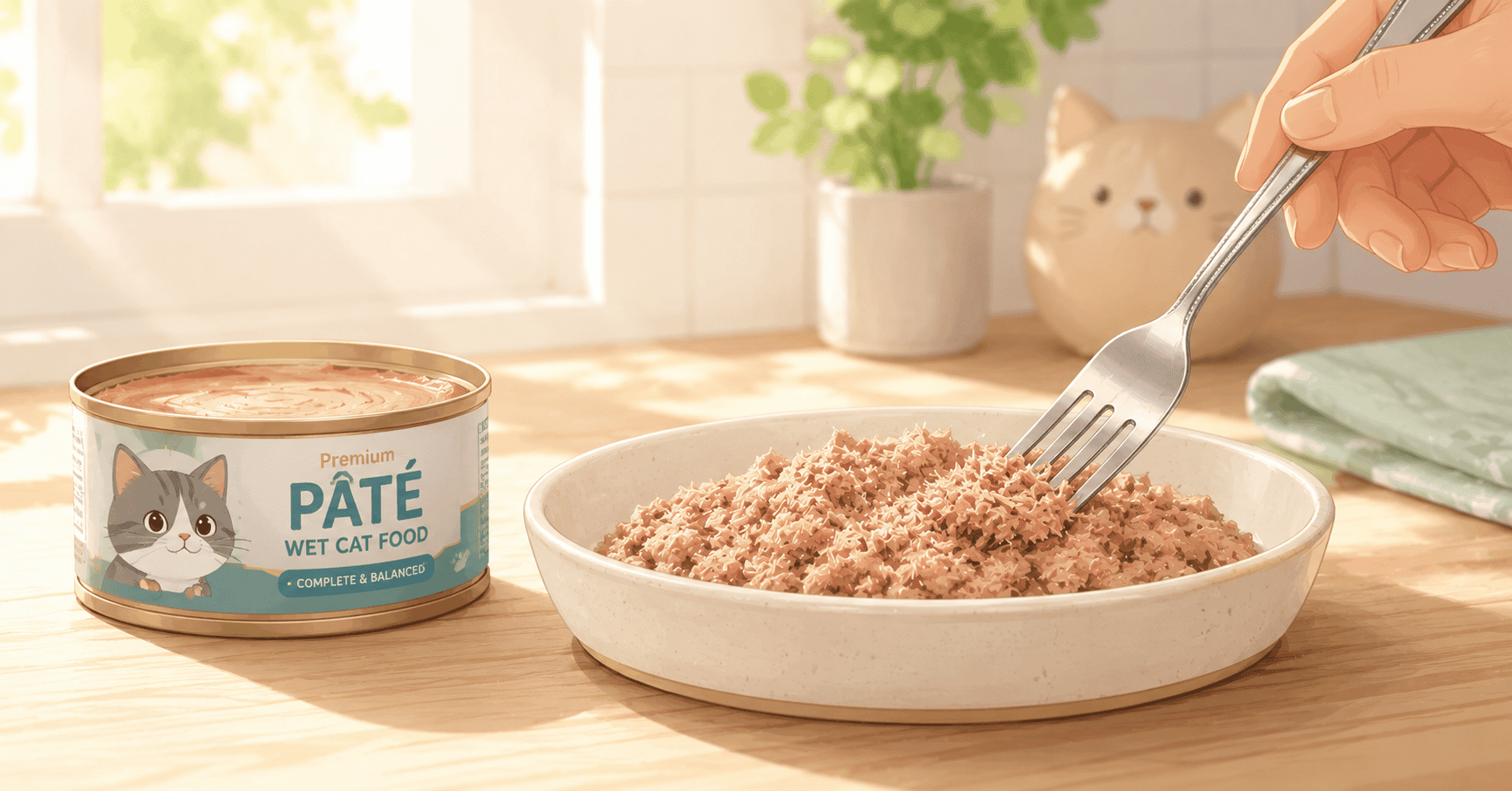
Step 1: Establish a baseline ratio. Begin with roughly 75% of the familiar gravy formula blended with 25% pate, mixed thoroughly so the textures and scents intermingle rather than sitting as separate piles in the bowl. Before serving, break up the pate portion with a fork — the uneven surface creates textural contrast, releases more aroma, and makes the dense consistency less confronting than a flat, smooth slab.
Step 2: Hold for 2-3 days. Resist the urge to advance the ratio daily. Cats need repeated, low-stakes exposure to a new texture before it stops registering as unfamiliar. Watch for consistent eating at this ratio before moving forward.
Step 3: Shift to a 50/50 blend. Once the cat is reliably finishing the 75/25 mix, move to an even split. This is typically the most sensitive phase, where partial refusal is common and expected.
Step 4: Progress to 75% pate, 25% gravy. Hold again for several days, monitoring appetite and stool consistency, since sudden texture changes can occasionally affect digestion.
Step 5: Complete the transition to 100% pate, ideally by day 7–10, depending on the individual cat’s responsiveness.
Throughout this process, distinguish true acceptance from stress-driven eating. A cat approaching the bowl with relaxed body language, steady tail position, and consistent finishing of portions is genuinely acclimating.
Conversely, hunching over the bowl, gulping rapidly, sniffing repeatedly without eating, or walking away and returning anxiously can indicate stress rather than enjoyment.
These behavioral cues matter because forcing a transition past genuine refusal can create lasting food aversion — which is exactly why the safety considerations in the next section matter just as much as the method itself.
A Lived-In Lesson From the Household — What Catch-him and Nick Taught Sandy About Patience
I’m a dog owner myself, not a cat owner, but my own household has taught me more about feline pickiness than I expected. My adventurous German Shepherd, Catch-him, and my tricolor companion dog, Nick, are about as far from selective eaters as you can get.
The moment their bowls hit the floor, it’s over in seconds flat, no sniffing, no hesitation, no theatrical pacing around the kitchen. For years, that was simply my entire frame of reference for what “mealtime” looked like.
So when I started fostering and consulting on cases involving picky cats, the contrast genuinely floored me.
I remember sitting with a friend’s cat, watching her approach a freshly served bowl of pate with the kind of caution Catch-him has never shown toward anything, not even unfamiliar dog food, new treats, or, honestly, the vacuum cleaner.
The cat circled the bowl twice, sniffed from three different angles, and walked away entirely, only to return ten minutes later and finally commit to eating.
That moment reframed everything for me. Nick and Catch-him’s enthusiasm isn’t a universal mammalian default; it’s a dog-specific trait shaped by very different evolutionary feeding pressures. Cats aren’t being difficult for the sake of it. Their hesitation is information, not stubbornness.
Watching my dogs’ uncomplicated relationship with food made me a more patient observer of feline behavior, not a more impatient one.
I stopped interpreting a cat’s pause at the bowl as defiance and started reading it as data: a scent that didn’t quite match expectations, a texture that needed more time.
Catch-him and Nick will never be the ones I’m troubleshooting pate refusal for, but their contrast taught me that patience, not persistence, is what actually wins a cat’s trust back at the bowl.
When Picky Eating Signals Something More — Red Flags That Need a Vet, Not a Topper
Every strategy covered so far assumes one critical thing: that the underlying cause of food refusal is behavioral or sensory, not medical. Distinguishing between the two is essential, because no topper, flavor enhancer, or transition schedule can resolve an issue rooted in actual illness.
Ordinary pickiness tends to be selective and inconsistent. A cat might skip pate but readily eat treats, drink water normally, stay playful, and show no other behavioral shifts. Medical anorexia looks different. It’s often total, persistent, and accompanied by other changes that signal something systemic is wrong.
The clearest red flag is duration. A healthy adult cat can typically tolerate short-term appetite dips, but any refusal to eat for more than 24 hours, or noticeably reduced intake lasting beyond 48 hours, warrants veterinary evaluation rather than continued home troubleshooting.
This matters even more for cats who are overweight, since prolonged inadequate caloric intake can trigger hepatic lipidosis, a serious and potentially life-threatening liver condition.
Other signs that point toward an underlying medical cause include vomiting, diarrhea, lethargy, hiding more than usual, drooling, bad breath, or visible weight loss.
Drooling and bad breath in particular can indicate dental disease or oral pain severe enough to make any food, regardless of texture, uncomfortable to chew. Lethargy paired with appetite loss is one of the most reliable combined indicators that something beyond preference is happening.
If you’ve worked through warming the food, introducing safe toppers, and a gradual gravy-to-pate transition without success, and any of these accompanying symptoms are present, it’s time to stop adjusting the bowl and start scheduling an exam.
Persistent appetite loss is never something to wait out indefinitely, and a veterinarian can rule out dental disease, gastrointestinal illness, or systemic conditions that home strategies simply cannot address.
The “Sandy-Proof” Conclusion — Your Scannable Action Plan
- Warm pate to room temperature before serving for maximum aroma release
- Blend gravy and pate gradually (75/25 → 50/50 → 75/25 → 100%) over 7-10 days
- Hold each ratio for 2-3 days before advancing
- Add plain, unseasoned chicken or fish broth as a safe flavor enhancer
- Mix in freeze-dried meat flakes for texture and scent boost
- Dilute with about 1 tsp water per ounce of pate for hydration support
- Avoid onion, garlic, dairy, and raw spinach garnishes entirely
- Watch for relaxed body language as a sign of true acceptance
- Note hunching, gulping, or repeated bowl avoidance as stress signals
- Call your vet for any refusal lasting 24-48+ hours
- Treat vomiting, lethargy, drooling, or weight loss as urgent red flags
- Never force a transition past genuine, persistent refusal