
Disclaimer: This article is intended for general educational purposes and does not replace a hands-on examination by a licensed veterinarian. Nighttime scratching or vocalizing that starts suddenly, intensifies, or comes paired with other changes can sometimes point to underlying medical conditions, including hyperthyroidism, feline cognitive dysfunction, or pain. If your cat’s behavior shifts abruptly or doesn’t respond to the steps below, please schedule a veterinary evaluation before relying on behavioral fixes alone.
By Sandy, Founder of Jet Set Paw
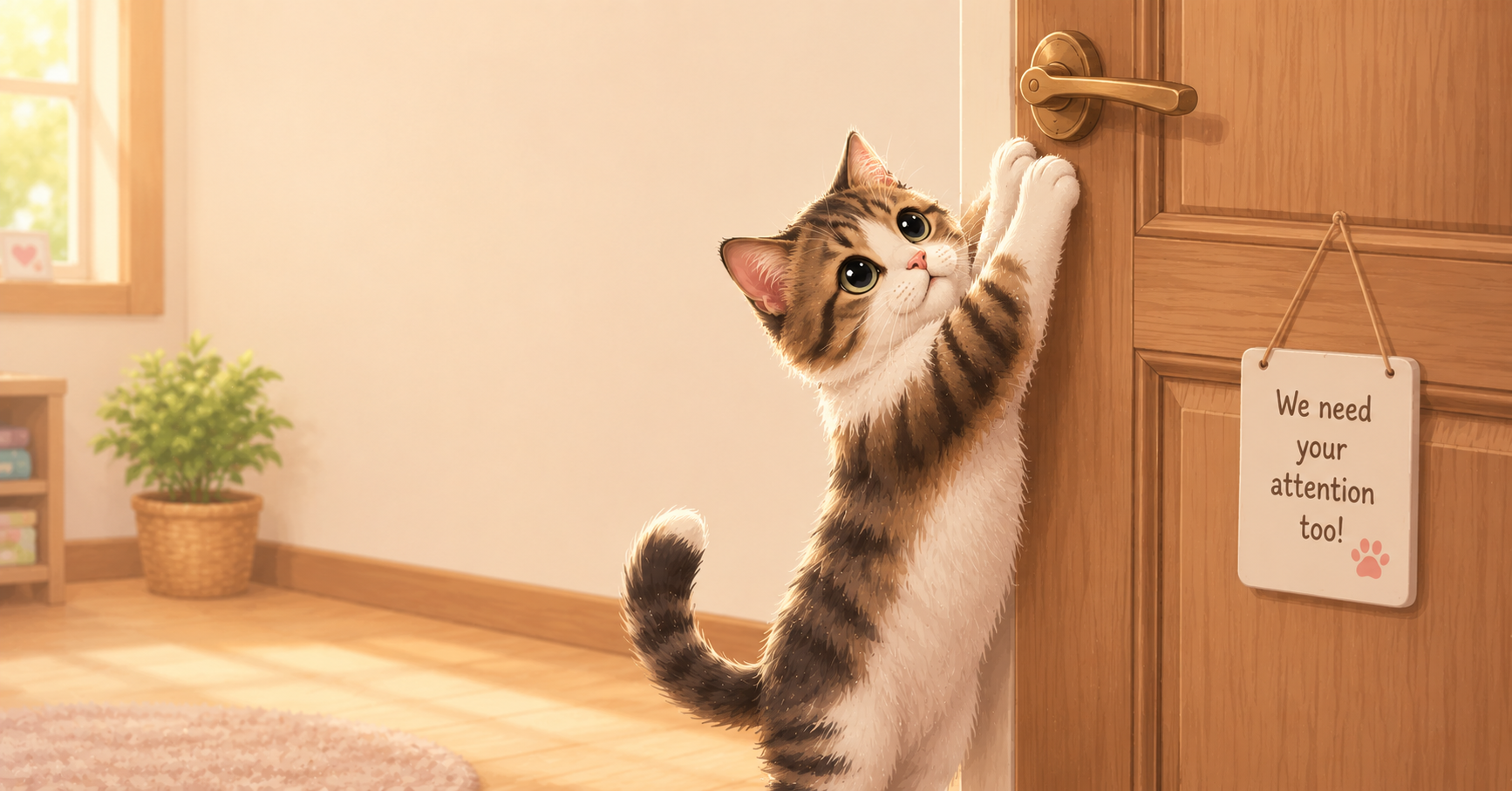
It’s 4:02 am, and the scratch-thud against my bedroom door has a rhythm I could set a clock to. If you’ve ever lain awake wondering how to stop cats from knocking on door rooms at night, you already know that sound, that pause, that second scratch, and the way it seems to vibrate straight through the wall.
My house has a strange acoustic profile for this exact problem. Catch-him, my adventurous German Shepherd, sleeps through it without lifting an ear, completely unbothered by feline diplomacy.
Nick, my tricolor Rat Terrier, is the opposite. The moment that door rattles, he’s up, alert, pacing the hallway like he’s been personally summoned to mediate.
I’ve spent enough 4 am mornings troubleshooting this exact scenario to know that punishment doesn’t work, isolation backfires, and yelling through the door only adds fuel to a behavior that’s often rooted in instinct, not defiance.
What follows is a calm, evidence-informed approach built from real nights in a real multi-pet household, one that protects your sleep without damaging the trust your cat has in you.
Jet Set Paw: The Quick Verdict
- Top 3 Root Causes: Attention-seeking (learned reinforcement), hunger or circadian misalignment, underlying anxiety or medical issue
- Most Effective Immediate Deterrent: A consistent pre-bedtime routine pairing structured play with a late feeding, paired with a designated calm zone outside the door
- Never Do This: Yell, spray water, or open the door to negotiate — all three reinforce the behavior or damage trust, even when they seem to work short-term
Decoding the 4 am Door Scratch — What Your Cat’s Schedule Is Really Telling You
Why does my cat scratch my door at 4 am? It’s the question I get asked most often, usually by someone who looks as tired as I felt during my first few weeks living with Nick’s nightly door-watch duty. The honest answer is that 4 am isn’t random.
It sits within a biological window that matters far more to your cat than to your alarm clock, and decoding what’s happening in that window is the first real step toward solving it.
| Behavior Pattern | Likely Cause | Urgency Level | First Response |
|---|---|---|---|
| Rhythmic scratching, stops if ignored | Attention-seeking (learned) | Low | Consistent ignoring, daytime enrichment |
| Scratching plus meowing near feeding time | Hunger / circadian misalignment | Low-Moderate | Adjust feeding schedule |
| Yowling, disorientation, scratching at night | Possible cognitive dysfunction | High — vet visit | Veterinary evaluation |
| Scratching paired with litter box avoidance | Possible medical/urinary issue | High — vet visit | Veterinary evaluation |
| Scratching with excessive thirst or weight loss | Possible hyperthyroidism or other illness | High — vet visit | Veterinary evaluation |
Crepuscular and Nocturnal Hunting Instincts Inherited From Wild Ancestry
Domestic cats retain a strong crepuscular instinct, meaning their wild ancestors hunted most actively at dawn and dusk, when prey species were also moving. That 4 am scratch often isn’t defiance; it’s an echo of a hunting window hardwired into the species long before cats ever slept on pillows.
How Feeding Schedules Shift the Internal Clock
Cats anticipate meals with remarkable precision. When the last feeding happens early in the evening, a cat’s internal clock can nudge that hunting instinct toward your door well before sunrise, making mealtime timing one of the simplest levers for shifting the behavior.
The Obligate Carnivore Clock — Biological and Behavioral Roots of Nighttime Restlessness
To understand the door scratch, it helps to understand what kind of animal you’re actually living with. Cats are obligate carnivores, a biological designation meaning their bodies are built specifically around a diet of animal prey, not just a preference but a metabolic requirement that shaped every part of their physiology, including the hunting drive that governs their internal clock.
That drive is crepuscular by design, tuned to dawn and dusk, the exact windows when a domestic cat’s energy spikes while the rest of the household is deep in REM sleep.
Nick understands this better than most humans do; he’s the first to notice when that energy surge starts building behind the door, well before I do.
This is where it matters to separate normal instinct from something that needs closer attention. A cat scratching rhythmically for a few minutes, then settling once ignored, is typically expressing a hardwired hunting or attention-seeking impulse, not distress.
Anxiety-driven or compulsive scratching looks different: it’s often relentless, paired with vocalizing that escalates rather than fades, and it doesn’t respond to the usual redirection techniques that work on instinct-driven behavior.
This distinction is exactly why the disclaimer at the top of this article isn’t a formality. Certain warning signs lie entirely outside the realm of normal nighttime restlessness.
Excessive thirst paired with nighttime restlessness can signal kidney involvement. Straining at the litter box, vocalizing in the box, or frequent unproductive attempts can point to calcium oxalate crystal formation or a developing urinary blockage, a genuine emergency in male cats especially.
Restlessness alone is rarely a cause for alarm. Restlessness alongside these specific signs is a reason to call your veterinarian before attempting any behavioral fix.
Attention-Seeking or Genuine Distress? Reading the Difference at Your Door
Once the biology is clear, the next question becomes diagnostic: is this cat scratching the bedroom door attention-seeking, or is something deeper going on?
The two can look nearly identical at 4 am, but they call for very different responses, and getting this wrong is usually where well-meaning owners accidentally make the problem worse.
Reinforcement Loops — How Opening the Door (Even to Scold) Trains the Behavior to Continue
Cats are exceptional pattern learners, and few patterns are easier to learn than “scratching makes the door open.” It doesn’t matter whether the response on the other side is a threat, a cuddle, or an exasperated “stop that” while you fling the door open.
From the cat’s perspective, the scratching worked. I learned this the hard way during my own early nights with a particularly persistent foster cat; every time I opened the door to scold her, the behavior intensified the following night, not because she was being defiant, but because I’d just reinforced exactly what I was trying to extinguish. Nick, predictably, found the whole ritual fascinating.
Distinguishing Attention-Seeking Patterns From Separation Anxiety or Pain-Driven Scratching
Attention-seeking scratching tends to be intermittent, escalating only if ignored, and it typically resolves once the cat receives daytime enrichment and a predictable routine.
Separation anxiety presents differently: scratching paired with distress vocalizing, pacing, or signs of panic when separated from a particular person, even during daylight hours.
Pain-driven scratching often shows physical tells, favoring a limb, hesitation before jumping, or flinching when touched near the door frame.
Correctly identifying which category your cat falls into isn’t optional groundwork; it’s the entire foundation of an effective response.
A solution built for attention-seeking will fail against separation anxiety, and a solution built for either will fail against an undiagnosed medical issue. The right next step depends entirely on getting this read correct first.
Risks of Common “Quick Fix” Reactions vs. Benefits of a Structured Response
It’s tempting, at 4 am, to reach for whatever stops the noise fastest. But the fastest fix and the right fix are rarely the same thing, and the gap between them is where most nighttime scratching problems quietly become long-term ones.
Punishment-based deterrents, water spray bottles, and yelling, chief among them, carry real risk. Cats don’t reliably associate the punishment with the behavior; instead, they often associate it with you, or with the door itself, which can erode trust or create fear-based responses that show up elsewhere, including redirected aggression toward other pets in the house.
Nick has no patience for tension in the house, and a startled, water-soaked cat skittering past him has, on more than one occasion in my own experience fostering anxious cats, turned into a tense standoff neither animal needed.
Inconsistency carries its own quiet cost. If the door opens on some nights and stays firmly shut on others, the behavior never gets the chance to fully extinguish.
Cats are remarkably good at testing whether last night’s rule still applies tonight, and an inconsistent response simply teaches them to keep trying.
Environmental and routine-based interventions work because they address the cause rather than punishing the symptom.
A predictable feeding and play schedule, a comfortable space outside the door, and a calm, consistent non-response all work with the cat’s biology instead of against it, which is why they tend to produce results that actually hold.
One safety note belongs here before moving into solutions: avoid essential-oil-based sprays as a deterrent near your cat’s environment.
Cats lack the liver enzymes needed to efficiently metabolize many plant-derived phenols, and essential oil exposure, even from diffusers or sprayed surfaces, has been linked to toxicity in cats. The next section covers genuinely safe deterrents.
The Step-by-Step Door-Peace Protocol — Deterrents, Routines, and Calm-Zone Setup
With the cause identified and the risks understood, here’s the protocol I rely on, refined over years of nights spent negotiating peace between Nick’s vigilance and a scratching cat’s persistence.
Pre-Bedtime Structured Play and a Late Feeding to Align With Natural Crepuscular Wind-Down
Roughly thirty to forty minutes before your own bedtime, run a structured play session, wand toys and chase games that mimic a hunt work best, followed immediately by the final meal of the day.
This sequence intentionally mirrors the natural hunt-eat-groom-sleep cycle, satisfying that crepuscular drive before it has the chance to peak at 4 am instead.
Building a Calm Zone Outside the Bedroom
A dedicated calm zone gives your cat somewhere better to direct that leftover energy. A window perch, a sturdy scratching post, and a puzzle feeder positioned just outside the bedroom door create an appealing alternative to the door itself, answering the practical question of how to keep your cat calm outside the bedroom door by giving them something worth staying for.
Safe Physical Deterrents vs. Extinction-Based Ignoring
Among the best cat scratching door deterrents are double-sided tape on the lower door panel, a draft stopper that dulls the scratching sound and sensation, and motion-activated air deterrents, all physically unpleasant enough to discourage scratching without frightening the cat.
Pair these with consistent ignoring: how to ignore a cat scratching the door successfully means no talking, no opening, no acknowledgment whatsoever, every single time, so the cat isn’t getting mixed signals from a deterrent on some nights and a worried owner’s voice on others.
The Consistency Window
Most attention-seeking behaviors show meaningful improvement within one to two weeks of consistent application. If scratching plateaus or worsens despite full consistency, that’s a signal to revisit Section 3’s warning signs and consider a veterinary evaluation rather than extending the behavioral approach further.
A Night in Sandy’s House — Putting the Protocol Into Practice
Last month, I fostered a sleek tabby cat for two weeks, and her first few nights gave me a real-time test of every piece of this protocol. The first night, I skipped the late feeding, distracted by a work call that ran long, and at 3:47 am, true to form, the scratching started.
I’d set up her calm zone the day before, a window perch and a puzzle feeder just past the bedroom threshold, but that first night she walked right past it, straight to the door. Nick was up instantly, ears forward, doing his usual hallway patrol, while Catch-him didn’t so much as shift on his dog bed.
I lay there for a solid ten minutes fighting the urge that anyone who’s tried this protocol will recognize: the 3 am math where opening the door for thirty seconds feels so much easier than holding the line.
I held it anyway. No talking, no light, no door. She scratched for about six minutes, paused, tried again briefly, then gave up, and eventually, I heard the unmistakable sound of the puzzle feeder being investigated instead.
By night four, after committing to the full pre-bed play session and late feeding every single evening, the scratching had dropped to occasional, half-hearted attempts that stopped almost immediately when ignored. By night seven, she was sleeping on her perch before I’d even turned off my own light.
Nick eventually stopped bothering to get up at all, which, for a dog who treats every household disturbance as a personal assignment, felt like the real victory. The protocol isn’t instant, and it isn’t always comfortable in the moment, but it works when you let it.
The “Sandy-Proof” Conclusion — Your Door-Peace Checklist
Peaceful nights aren’t about winning a standoff with your cat; they’re about working with the instincts already wired into them. Here’s the checklist I keep coming back to, in my own house and every foster home since:
- Feed and play in the final hour before bed, timed to the natural wind-down window
- Build a calm zone, not a punishment zone, somewhere just outside the door, worth staying for
- Ignore consistently — no talking, no opening, no negotiating through the door
- Choose deterrents that redirect, not frighten — tape and draft stoppers over sprays or scolding
- Track patterns for two weeks before escalating to new tactics
- Call the vet if scratching is paired with changes in appetite, thirst, or litter box habits
Nick still keeps watch some nights out of habit more than necessity. Catch-him still sleeps through all of it. And the door, more often than not these days, stays quiet until morning.