General Safety & Medical Disclaimer
The information provided in this article is intended for general educational purposes only and does not constitute professional veterinary or legal advice. Stray and feral cats may carry zoonotic diseases including rabies, Toxoplasma gondii, ringworm (Microsporum canis), and Bartonella henselae (cat scratch disease). Always wear puncture-resistant gloves when handling unknown animals. Consult a licensed veterinarian or your local animal control authority before transporting any stray or feral cat. Jefferson County municipal codes and Alabama state law govern stray animal handling; compliance is the reader’s sole responsibility.
By Sandy, Founder of Jet Set Paw
It started on a Tuesday evening, the kind of humid Alabama dusk that makes the air feel thick enough to hold. My German Shepherd, Catch-him, froze mid-stride on our neighborhood walk — ears forward, nose locked onto something beneath a rusted chain-link fence two houses down.
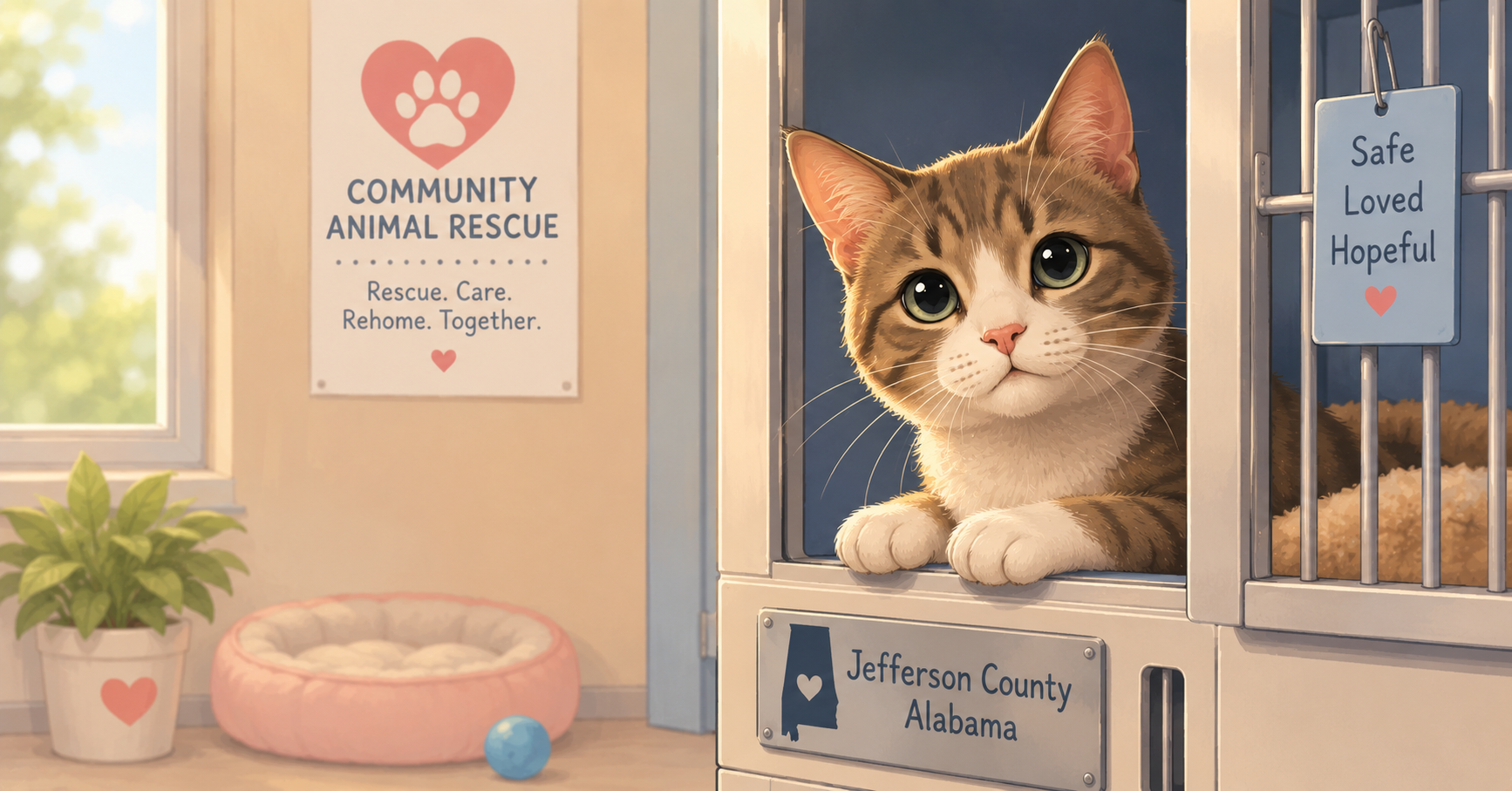
Tucked against the concrete, barely visible in the fading light, was a small tabby cat, thin-ribbed and silent. If you’ve ever stood in that exact moment — holding a flashlight over a frightened stray cat in Jefferson County, Alabama, with no idea where to carry it or who to call — then you already understand why this guide exists.
Knowing where to carry stray cats in Jefferson County, Alabama isn’t instinctive. It isn’t posted on neighborhood signs.
And in the fog of that moment, with Catch-him straining at his leash and my tricolor dog Nick circling curiously behind me, I realized I was making educated guesses about a system I’d never had to navigate before.
That hesitation cost time — and for a dehydrated, vulnerable animal, time is a clinical variable, not a minor inconvenience.
The truth is, Jefferson County has a layered intake ecosystem: a government-contracted humane society operating as the county’s official Animal Care and Control division, cities with their own independent animal control officers, and TNR-based community cat programs — each with different eligibility rules, jurisdictions, and hours.
Getting the wrong resource means delays, turned-away animals, or worse, a well-meaning surrender that lands a feral cat in an inappropriate placement.
This guide removes every layer of that confusion. What follows is a verified, location-specific breakdown of exactly where to go, who to call, and what to do — starting with the fastest answer first.
Jet Set Paw: The Quick Verdict
Where to carry a stray cat in Jefferson County, Alabama — fast answers:
- GBHS Animal Care & Control (ACC) — Primary Intake Facility: 6227 5th Avenue North, Birmingham, AL 35212 — Call 205-591-6522 (24/7/365) to report strays, request officer dispatch, or arrange drop-off
- GBHS Snow Drive Adoption & Surrender Center: 300 Snow Drive, Birmingham, AL 35209 — Call 205-942-1211 — pet surrender by appointment only
- Cities with independent ACOs (GBHS has NO jurisdiction): Hoover, Adamsville, Hueytown, Bessemer, Mountain Brook, Vestavia Hills, Homewood, Birmingham — contact your city’s police dispatch directly
- Feral or community cats — TNR pathway: Alabama Spay/Neuter Clinic — call (205) 703-7729 for trap loan and surgical appointment; Country Cattery for Jefferson County colony support
- Animal cruelty or neglect concerns: Jefferson County Sheriff’s Office Animal Cruelty Unit — report via the GBHS cruelty hotline or Jefferson County Sheriff’s non-emergency line
- Any bite or scratch to a human: Call Jefferson County Department of Health immediately — mandatory 10-day quarantine observation applies under Alabama law
Understanding Who Handles Stray Cats in Jefferson County — Jurisdiction, Authority, and the Intake Ecosystem
Most people treat “animal control” as a single, monolithic system. In Jefferson County, Alabama, it isn’t. The county operates a layered intake ecosystem made up of a government-contracted humane organization, independent municipal animal control officers, and community-based rescue networks — each with distinct authority, eligibility criteria, and geographic reach.
Calling the wrong agency doesn’t just waste time; it can mean a vulnerable animal waits hours longer than necessary for care.
Before you load a cat into a carrier, you need to know two things: where the animal was found, and what kind of cat you’re actually dealing with.
A stray cat is a domestic Felis catus that is lost, abandoned, or separated from a household — typically approachable, showing signs of prior human socialization.
A feral cat is an unsocialized, free-roaming animal that has had little to no positive human contact, often since birth. This distinction is not semantic.
It directly determines which intake pathway is legally and operationally appropriate, and most Jefferson County facilities will make this classification themselves upon arrival.
GBHS Animal Care & Control vs. City-Level Animal Control — Which Has Authority Over Your Location?
Since January 2015, the Greater Birmingham Humane Society Animal Care and Control, LLC — operating as a wholly-owned subsidiary of GBHS — has served as the contracted governmental animal control operator for unincorporated Jefferson County and select municipalities.
This is not a private nonprofit acting independently; it is the legally designated Animal Care and Control authority for the county, operating under a contract awarded by the Jefferson County Commission.
However, GBHS ACC’s jurisdiction has firm boundaries. Eight cities within Jefferson County maintain their own independent animal control officers and operate entirely outside GBHS ACC authority:
Cities with independent ACOs — GBHS has no pick-up authority:
Hoover, Adamsville, Hueytown, Bessemer, Mountain Brook, Vestavia Hills, Homewood, and the City of Birmingham proper.
If you find a stray cat inside any of these city limits, contact that city’s police dispatch directly — not GBHS ACC. GBHS has stated plainly that it has no authority to pick up animals in these jurisdictions without a signed agreement from the local police department.
All remaining unincorporated Jefferson County areas and smaller municipalities — including Clay, Fairfield, Fultondale, Irondale, Midfield, Pinson, Trussville, and municipalities under 5,000 residents — fall under GBHS ACC coverage.
Reference Table — Stray Cat Intake Resources in Jefferson County, Alabama
| Organization | Type | Accepts Strays? | Accepts Ferals? | Address | Phone | Hours |
|---|---|---|---|---|---|---|
| GBHS Animal Care & Control (ACC) | Gov’t-contracted nonprofit subsidiary | Yes | Case-by-case | 6227 5th Ave N, Birmingham, AL 35212 | 205-591-6522 | Mon–Fri 10am–4:30pm; Sat 9–11:30am; 24/7 phone |
| GBHS Snow Drive (Surrender/Adoption) | Private nonprofit | Yes (by appt) | TNR referral | 300 Snow Dr, Birmingham, AL 35209 | 205-942-1211 | Tue–Sat 1pm–5pm; surrender by appt |
| GBHS ACC Jasper | Gov’t-contracted | Yes | Case-by-case | 2302 Birmingham Ave, Jasper, AL 35501 | 205-221-6621 | Tue–Sat 11am–5pm; Sun 12–5pm |
| Alabama Spay/Neuter Clinic | TNR/Community Cat | No | Yes | Jefferson County area | 205-703-7729 | By appointment |
| Country Cattery | TNR/Rescue nonprofit | No | Yes | Jefferson, Shelby, Chilton, St. Clair counties | Via Facebook/email | By arrangement |
Hours and intake policies change seasonally and with shelter capacity. Always call ahead before transporting any animal.
The Intake Pathways — Step-by-Step Guide to Surrendering or Reporting a Stray Cat in Jefferson County
Now that you know who holds authority in Jefferson County’s intake ecosystem, the next question is operational: what exactly do you do, in what order, from the moment you encounter a stray cat to the moment it is safely in professional hands?
Follow these steps without skipping sequence. Each one protects the animal, protects you, and ensures the intake process moves without preventable delays.
Step 1: Observe Before You Touch
Spend 60 to 90 seconds watching the cat from a safe distance. Note its body condition, approximate age, behavioral presentation, and any visible injuries. Is it approaching you or retreating? This behavioral read will determine your intake pathway before you make a single call.
Step 2: Contain Safely — Carrier or Humane Trap Only
If the cat is approachable, use a hard-sided carrier with a secure latch. For skittish or fractious animals, a humane box trap (such as a Tomahawk or Havahart model) is the appropriate containment tool.
Never scruff or manually restrain an unknown stray without puncture-resistant gloves. Do not attempt containment of any cat displaying neurological symptoms — erratic movement, unprovoked aggression, or excessive salivation — without first calling GBHS ACC at 205-591-6522 for officer assistance.
Step 3: Document Everything
Before transport, photograph the cat, GPS-pin the exact found location, and note the date, time, and how long you observed the animal. This documentation is not optional — it is required disclosure at intake.
Step 4: Phone Triage — Call the Right Resource First
- Found in unincorporated Jefferson County or a GBHS-covered municipality → GBHS ACC: 205-591-6522 (24/7/365)
- Found inside Hoover, Bessemer, Homewood, Mountain Brook, Vestavia Hills, Hueytown, Adamsville, or Birmingham city limits → Contact that city’s police dispatch — GBHS has no jurisdiction
- Behaviorally feral cat anywhere in Jefferson County → Alabama Spay/Neuter TNR line: 205-703-7729 or Country Cattery via Facebook
- Owner surrender or stray drop-off by appointment → GBHS Snow Drive: 205-942-1211
Step 5: Transport Protocols
Secure the carrier in your back seat or cargo area — never loose in a vehicle. Cover the carrier with a light towel to reduce cortisol-driven stress responses during transit.
Do not offer food or water during transport unless a veterinarian has advised otherwise for a medically compromised animal.
Step 6: Intake Disclosure — What You Must Tell Staff
For any stray cat surrender Jefferson County AL residents process through a shelter or control facility, staff will require: the precise found location, duration of your observation period, your contact information, and — critically — disclosure of any bite or scratch incidents.
Under Alabama Code § 3-7A, a cat that has bitten a human triggers mandatory rabies exposure protocols. Concealing bite history at intake is not only dangerous; it removes your legal protection in the event of subsequent illness.
Step 7: What Happens at Intake
At GBHS ACC intake, every animal receives full vaccinations, flea and tick treatment, and a veterinary assessment — including 24/7 veterinary coverage for after-hours intake. Adult cats and kittens receive FVRCP vaccines immediately on intake.
Animals then enter a state-mandated 7-day stray hold — not 5 days — during which owners may reclaim by providing proof of ownership and paying applicable fees.
After the 7-day hold, cats deemed adoptable are tested for FeLV/FIV, begin additional preventive medical treatment, and are transferred to the GBHS Snow Drive adoption facility. Staff will classify the animal as stray or feral and assign the appropriate care pathway.
Stray vs. Feral — Why the Biological and Behavioral Distinction Changes Everything About Intake Eligibility
The domestic cat, Felis catus, is an obligate carnivore — a species physiologically dependent on animal-sourced protein for survival, with a neurological architecture built around territorial awareness, threat assessment, and predatory vigilance.
These instincts do not disappear in domestication; they are modulated by early socialization. And it is precisely that socialization history — not coat color, body condition, or even friendliness in a single moment — that determines whether a cat in Jefferson County qualifies for standard shelter intake or gets redirected to an entirely different care pathway.
The critical developmental window opens at approximately 2 weeks postnatal and closes around 7 weeks. During this period, a kitten’s brain is neurologically primed to form positive associations with human contact.
A kitten handled consistently and positively during this window develops the behavioral profile of a socialized domestic cat. A kitten that experiences little or no human contact during these weeks does not simply become shy — it develops a fundamentally different threat-response baseline.
By adulthood, that animal is behaviorally feral: it perceives humans as predators, not caretakers, regardless of how well-fed or physically healthy it may be.
This is why Jefferson County intake officers do not use appearance to classify animals. They use behavior.
How Intake Officers Behaviorally Classify a Cat in Under 60 Seconds
Upon arrival, intake staff typically assess: response to direct eye contact, reaction to a slow hand approach, vocalization type (hissing and silent flattening versus meowing and slow blink), and body posture under mild handling pressure.
A cat that crouches, freezes, and refuses eye contact while showing piloerection — raised fur along the dorsal line — will be classified as feral regardless of how thin or approachable it appears outdoors. This triage takes less than a minute and determines the entire subsequent care pathway.
Most Jefferson County shelters, including the Greater Birmingham Humane Society, do not accept behaviorally confirmed feral adults for standard intake.
Placing an unsociable adult cat in a standard shelter environment produces extreme chronic stress, suppresses immune function, and carries a poor welfare and adoption outcome. These animals are instead redirected to Trap-Neuter-Return programs.
TNR in Jefferson County — What Feral Colony Managers Need to Know
Trap-Neuter-Return is the evidence-based, internationally recognized methodology for managing community cat populations.
A feral cat is humanely trapped, surgically sterilized and vaccinated under veterinary supervision, ear-tipped on the left ear for visual field identification, and returned to its established territory.
For feral cat TNR in Birmingham, AL, residents and colony managers, Spay Alabama is the primary regional partner, offering low-cost trap loans, surgical appointments, and colony registration guidance.
TNR does not place feral cats into homes. It stabilizes outdoor colonies, eliminates reproduction, reduces nuisance behaviors driven by hormonal cycles, and — critically — vaccinates animals against rabies, directly reducing public health risk in Jefferson County communities.
Health screening expectations at standard stray intake include: FIV/FeLV (feline immunodeficiency virus and feline leukemia virus) antigen testing, external parasite assessment for Ctenocephalides felis (cat flea) infestation and associated Dipylidium caninum tapeworm burden, dermatophyte screening for Microsporum canis (ringworm), and upper respiratory triage targeting feline herpesvirus type 1 (FHV-1) and feline calicivirus (FCV) — the two pathogens responsible for the overwhelming majority of shelter upper respiratory infections.
Both are highly contagious in intake environments and drive population-level health management protocols at every Jefferson County facility.
The Human Safety Layer — Zoonotic Disease Risks, Handling Protocols, and What Every Jefferson County Resident Must Know Before Touching a Stray
Compassion is the right instinct when you encounter a stray cat. Unprotected contact is not. Alabama is a rabies-endemic state, with documented transmission cycles maintained in raccoon, bat, fox, and skunk populations throughout Jefferson County and the broader Birmingham metro area.
Domestic cats — particularly free-roaming strays with unknown vaccination history — sit within that transmission risk environment every day.
Understanding the zoonotic disease landscape before you touch an unknown animal is not overcaution. It is the clinical baseline for responsible intervention.
Rabies (Lyssavirus) represents the highest-consequence exposure in this category, even if statistically low-probability when proper protocols are followed.
Any stray cat bite or scratch that breaks the skin requires immediate reporting to the Jefferson County Department of Health and triggers a mandatory 10-day quarantine observation period under Alabama Code § 3-7A.
Do not wait for symptoms. Do not self-monitor at home without medical guidance. Report first, assess second.
Beyond rabies, four zoonotic categories demand awareness from any Jefferson County resident handling a stray:
1. Bacterial — Bartonella henselae (Cat Scratch Disease) Transmitted via scratch or inoculation of flea feces (Ctenocephalides felis) into broken skin. Presents in immunocompetent individuals as regional lymphadenopathy and low-grade fever.
In immunocompromised patients, systemic Bartonella infection carries significantly elevated morbidity risk. Flea control in the handling environment, not just the cat, is a critical secondary prevention step.
2. Parasitic — Toxoplasma gondii. Felis catus serves as the definitive host for T. gondii, shedding environmentally resistant oocysts in fecal material for 1–3 weeks following primary infection. Oocysts become infective 1–5 days post-shedding.
Risk is highest for immunocompromised individuals and pregnant persons — T. gondii crosses the placental barrier and can cause severe fetal neurological damage.
Never handle stray cat feces without gloves, and wash hands thoroughly with soap and water — not hand sanitizer alone — after any contact with litter or soil in areas frequented by cats.
3. Fungal — Dermatophytosis (Microsporum canis) Ringworm is not a worm. It is a superficial fungal infection of keratinized tissue — skin, hair, and nails — caused primarily by Microsporum canis in cat-to-human transmission events.
Direct contact with an infected cat’s coat is sufficient for transmission. Stray cats with patchy, scaly, or alopecic (hair-loss) lesions — particularly around the face and ears — should be handled with maximum skin coverage until a veterinarian clears them.
4. Viral — Rabies (Lyssavirus) As noted above: highest consequence, protocol-governed, non-negotiable in reporting. A cat displaying unprovoked aggression, apparent disorientation, hypersalivation, or photophobia should not be approached or contained by a member of the public under any circumstances. Call animal control in Jefferson County, Alabama, immediately and maintain distance.
Handling Protocol — Non-Negotiable Minimum Standards:
- Puncture-resistant gloves (nitrile alone is insufficient for a fractious cat — use cut-resistant or leather-reinforced gloves)
- Long sleeves, closed-toe shoes
- Eye protection if the cat is fractious or spraying
- No face-level contact at any point during handling or transport
- Wash all exposed skin with soap and water immediately after contact
When to Call 911 vs. Animal Control vs. a Vet
| Situation | Call |
|---|---|
| Cat is injured, aggressive, or displaying neurological symptoms | Animal Control — (205) 785-1743 |
| You or another person has been bitten or scratched | 911 + Jefferson County Dept. of Health immediately |
| Cat appears ill, dehydrated, or injured, but is contained and calm | Veterinarian or emergency animal clinic |
| The cat is deceased on public property | Animal Control for removal |
| A cat has bitten a child or an immunocompromised person | 911 first, then animal control and health department |
Sandy’s Field Notes — What Happened the Day Catch-him Found a Stray in Our Jefferson County Neighborhood
I remember exactly what the light looked like — that flat, gold-orange late afternoon light that hits the older neighborhoods in Jefferson County and makes everything look slightly more cinematic than it is.
Catch-him and I were three blocks into our evening walk when he stopped dead, hackles barely raised, and locked his gaze on the crawl space beneath a neighbor’s porch. My tricolor dog Nick was trailing us that day, moving at his usual unhurried pace, and even he paused.
Tucked against the lattice, partially hidden behind a rusted downspout, was a young cat. Maybe six months old. Thin in the way that means more than missing a meal — visible hip points, dull coat, the kind of stillness that reads less like calm and more like exhaustion.
But here was the detail that mattered: when I crouched down and made slow eye contact, it meowed. Quietly, hoarsely, but it meowed. It did not flatten. It did not hiss. It held my gaze.
That single behavioral cue told me what I needed to know: this was not a feral animal. This was a stray — a socialized domestic cat that had lost its way into the wrong circumstances.
And because we were in unincorporated Jefferson County — not inside Birmingham, Hoover, or Bessemer city limits — I knew exactly which authority had jurisdiction.
I did not pick it up. I went back to the house, retrieved my hard-sided carrier and my puncture-resistant gloves, and returned.
I documented everything first — photos, GPS pin, time stamp, behavioral notes — exactly the way I’d want any intake officer to receive the information.
Then I made the call: 205-591-6522, the GBHS Animal Care and Control line, available 24 hours a day, seven days a week.
I arranged drop-off at the Greater Birmingham Humane Society ACC intake facility on 5th Avenue North. The staff was efficient, calm, and thorough.
The cat was scanned immediately for a microchip (none found), received FVRCP vaccines on intake per standard protocol, and entered the state-mandated 7-day stray hold.
From there, if unclaimed, she would be assessed for FeLV/FIV and transferred to the Snow Drive adoption center.
What I felt standing at that intake desk — handing over an animal I’d known for forty minutes — was a strange mixture of relief and helplessness. I’d done everything correctly, and I still felt the weight of not knowing what came next.
But here’s what I also felt: grateful that I knew exactly who to call. Not every Birmingham, Alabama stray cat rescue situation resolves this cleanly.
Some start with the wrong call to the wrong agency, a turned-away animal, a missed window of care. The difference, almost always, is preparation.
That experience made me want to build the guide I wish I’d had.
Local Resources Deep-Dive — Greater Birmingham Humane Society, Jefferson County Animal Control, and TNR Partners Compared
Knowing that resources exist and knowing how each one actually operates are two different levels of preparedness.
This chapter adds the qualitative layer — the operational context behind each organization — so that when you make contact, you arrive informed rather than dependent on intake staff to walk you through a process you could have understood in advance.
GBHS Animal Care & Control — The County’s Contracted Operator
The Greater Birmingham Humane Society Animal Care and Control, LLC is not simply a private humane organization that also handles strays.
It is a wholly-owned subsidiary of GBHS and the legally contracted governmental animal control operator for Jefferson County — awarded the county contract in December 2014 and operational since January 2015, replacing the former for-profit vendor at approximately 60% cost savings to taxpayers. In its first year alone, GBHS ACC took in more than 18,000 animals.
Its primary intake facility is located at 6227 5th Avenue North, Birmingham, AL 35212 — the Woodlawn facility that serves as the operational hub for all stray animal intake in GBHS-covered jurisdictions. The phone line — 205-591-6522 — operates 24 hours a day, 7 days a week, 365 days a year. After-hours calls are answered by an on-call officer who returns calls within 10 minutes.
Public intake hours at the Woodlawn facility: Monday through Friday, 10 am–4:30 pm; Saturday 9–11:30 am; Sunday closed. Emergency response and on-call officers operate Saturday noon through Monday 8 am and weekday evenings from 5 pm to 8 am.
All animals entering ACC intake receive full vaccinations, flea and tick treatment, and veterinary assessment. Adult cats and kittens receive FVRCP vaccines on intake. All incoming animals are scanned for ISO 11784/11785-compliant microchips — if a chip is detected, owner lookup is initiated before the animal is processed as a stray, closing the gap between lost and truly abandoned cats within minutes.
After intake, animals enter the legally mandated 7-day stray hold — not 5 days. Animals not reclaimed within that window are transferred to the GBHS Snow Drive adoption facility at 300 Snow Drive, Birmingham, AL 35209 (205-942-1211) for adoption processing, which includes FeLV/FIV testing, full preventive care, surgical sterilization, and microchipping.
Pet surrender at Snow Drive is by appointment only. Adoption center hours: Tuesday–Saturday, 1 pm–5 pm.
A second GBHS ACC location serves Walker County and the Jasper area: 2302 Birmingham Ave, Jasper, AL 35501 — (205) 221-6621 — open Tuesday through Saturday 11 am–5 pm, Sunday 12–5 pm, Monday closed.
GBHS ACC covers unincorporated Jefferson County and smaller municipalities only. The following cities have independent ACOs and fall entirely outside GBHS jurisdiction: Hoover, Adamsville, Hueytown, Bessemer, Mountain Brook, Vestavia Hills, Homewood, and the City of Birmingham. If your found cat is in any of these cities, contact that city’s police dispatch — not GBHS ACC.
A major infrastructure development: in August 2024, the Jefferson County Commission awarded a $21 million contract to Stone Building to construct a new Jefferson County Animal Care and Control Facility — a purpose-built, modern replacement for the aging Woodlawn facility.
This project represents the most significant investment in Jefferson County animal services infrastructure in decades and will substantially expand intake capacity and medical services when complete.
Cities With Independent Animal Control — Who to Call
If your found cat is within one of the eight independently-operated cities, bypass GBHS ACC entirely and contact the relevant municipal authority:
| City | Contact |
|---|---|
| City of Birmingham | Birmingham Animal Services: 205-297-4028 |
| Hoover | Hoover Police Dept non-emergency dispatch |
| Bessemer | Bessemer Police Dept / Bessemer Humane Society |
| Homewood | Homewood Police Dept non-emergency dispatch |
| Mountain Brook | Mountain Brook Police Dept non-emergency dispatch |
| Vestavia Hills | Vestavia Hills Police Dept — note: city has TNR ordinance (Ordinance 2652) for feral cats |
| Hueytown | Hueytown Police Dept non-emergency dispatch |
| Adamsville | Adamsville Police Dept non-emergency dispatch |
Always call ahead to verify current intake availability before transport.
TNR Partners — Feral Cat Management in the Birmingham Metro
For feral cat TNR Birmingham AL colony managers and residents dealing with unsocialized community cats, two primary partners operate in Jefferson County:
Alabama Spay/Neuter Clinic offers subsidized surgical sterilization, rabies vaccination, and ear-tipping for community cats, plus trap loans with a $65 refundable deposit. A maximum of three cats per caretaker per appointment on Monday, Tuesday, or Wednesday — appointment required. Call (205) 703-7729.
Country Cattery is a Jefferson County-based nonprofit specifically focused on feral and friendly community cats — including TNR, veterinary care, foster programs, and adoption — covering Jefferson, Chilton, Shelby, and St. Clair counties.
Free community cat sterilization is also available through the GBHS Spay/Neuter & Critical Care Clinic at 5220 Princeton Way, Hoover, AL 35226 — (205) 898-7812. Contact Country Cattery via Facebook or email for colony support.
The Sandy-Proof Conclusion — Your Action Checklist for Carrying a Stray Cat in Jefferson County, Alabama
Every resource, protocol, and zoonotic precaution in this guide distills into one practical truth: preparation is the variable that separates a successful intake from a preventable delay.
Whether it’s your first encounter or your fifth, the following checklist covers the complete arc — from the moment you spot a stray to the moment you walk away from intake knowing you did everything right.
The Sandy-Proof Stray Cat Intake Checklist
First Sighting
- Observe from a safe distance — minimum 60 seconds before approach
- Assess behavioral presentation: approachable (stray pathway) vs. retreating/fractious (feral pathway)
- Note body condition, approximate age, visible injuries
Safe Containment
- Gloves on before any contact — puncture-resistant, not nitrile alone
- Hard-sided carrier for socialized cats; humane box trap for fractious or skittish animals
- Never manually restrain a cat displaying neurological symptoms — call GBHS ACC first: 205-591-6522
Documentation
- Photograph the animal in situ
- GPS-pin the exact found location
- Record date, time, and observation duration
Phone Triage — Call the Right Resource
- Unincorporated Jefferson County or GBHS-covered municipality → GBHS ACC: 205-591-6522 (24/7/365)
- Inside Hoover, Bessemer, Birmingham, Homewood, Mountain Brook, Vestavia Hills, Hueytown, or Adamsville → Contact that city’s police dispatch directly
- Feral or community cat → Alabama Spay/Neuter: (205) 703-7729 or Country Cattery
- Owner surrender by appointment → GBHS Snow Drive: 205-942-1211
Transport
- Carrier secured — not loose in vehicle
- Light towel over carrier to reduce stress response
- No food or water during transport unless veterinarian-directed
Intake Disclosure — Required, Non-Negotiable
- Precise found location
- Duration of observation
- Any bite or scratch incidents — report immediately under Alabama Code § 3-7A
- Your contact information
Post-Contact Hygiene Protocol
- Wash all exposed skin with soap and water — not hand sanitizer alone
- Change clothing worn during handling before contact with personal pets
- Monitor any scratch or puncture site for 72 hours; seek medical evaluation if redness or swelling develops
- Report any bite to Jefferson County Department of Health same day
Your Ongoing Resource
- Bookmark Jet Set Paw for updated Jefferson County and Greater Birmingham pet care guidance, shelter news, and seasonal intake alerts
Knowing exactly where to carry stray cats in Jefferson County, Alabama — and how to do it safely, correctly, and with the right contacts already in hand — is the difference between hesitation and action when an animal needs you most