
Veterinary Disclaimer: This article is intended for general informational purposes only and does not substitute for professional veterinary medical or behavioral advice. If your cat is showing signs of aggression, has been injured in a fight, or you have ongoing concerns about multi-pet conflict, please consult a licensed veterinarian or a certified veterinary behaviorist for an evaluation tailored to your pet.
By Sandy, Founder of Jet Set Paw
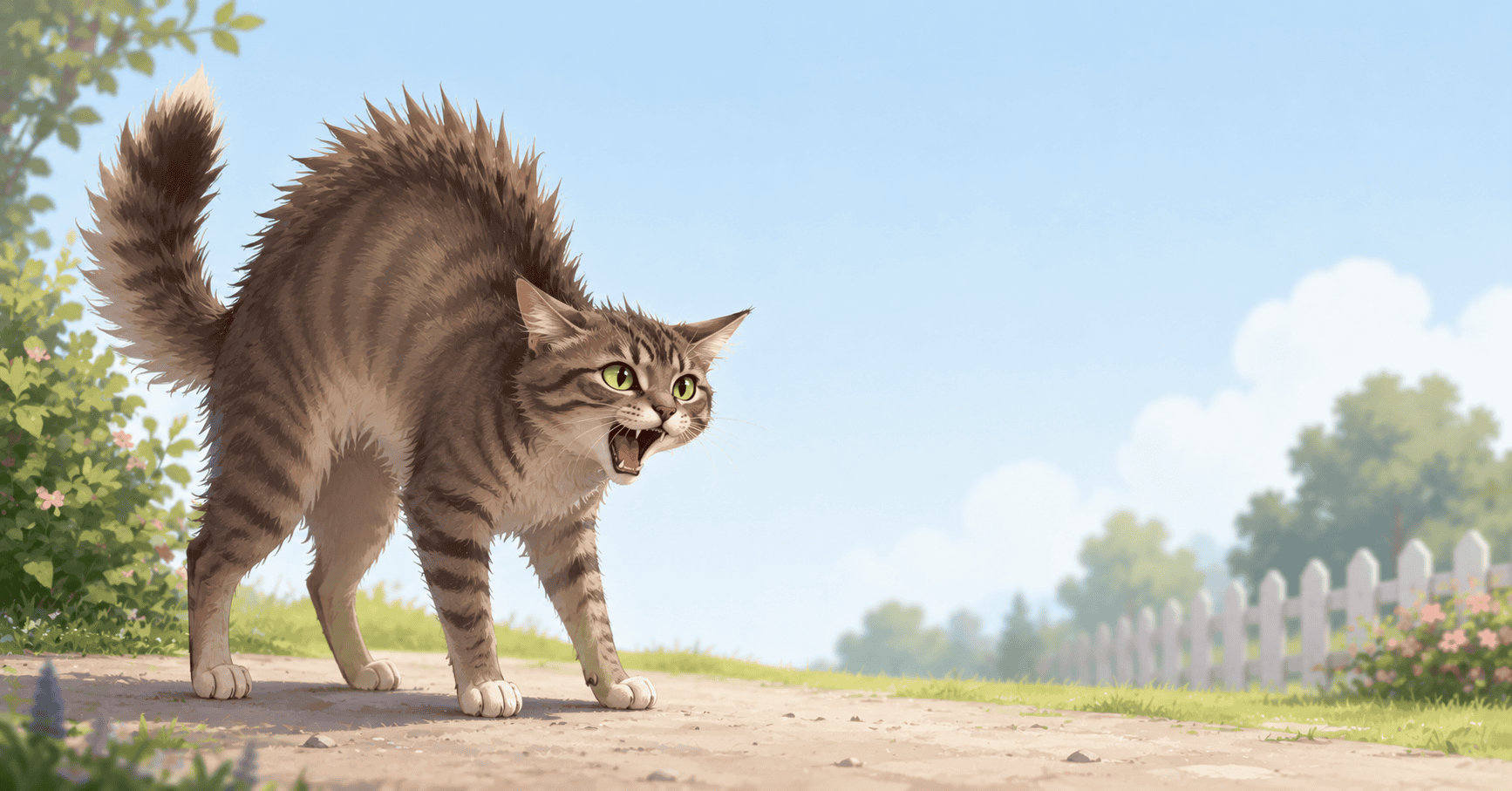
I still remember the exact sound that pulled me to my client’s back window: a low, guttural growl followed by a yowl that didn’t sound like any normal cat conversation. Two cats were squared off on the patio, and within seconds, their fur had transformed them into something almost twice their actual size.
That’s the moment most people first ask why do cats raise their hair in a fight, and it’s a question I’ve fielded more times than I can count over years of working alongside frightened, defensive, and downright furious felines.
What I want you to understand right away is that this isn’t random rage or a “switch flipping.” Raised fur during a confrontation is one of the most ancient, hardwired survival signals a cat possesses, a visual bluff designed to end a fight before it ever starts. It’s biology doing exactly what it evolved to do.
In this article, we’re going to walk through the actual physiology behind that puffed-up silhouette, how to read the difference between a frightened cat and a genuinely aggressive one, and most importantly, how you can safely step in without becoming collateral damage yourself.
Jet Set Paw: The Quick Verdict
Cats raise their hair through piloerection, an involuntary reflex where the arrector pili muscles attached to each hair follicle contract under sympathetic nervous system activation, making the cat appear larger and more threatening to an opponent.
- A puffed tail, specifically, often signals heightened fear or defensive arousal, not just aggression
- Fearful piloerection (sideways stance, flattened ears) differs from confident, offensive piloerection (direct approach, low tail)
- This reflex is involuntary; the cat cannot simply “calm down” on command in the moment
- Never attempt to separate fighting cats with your bare hands; redirected bites and scratches are a leading cause of injury
The Body’s Alarm System — What Piloerection Actually Is
What you witnessed on that patio wasn’t a behavioral choice; it was a cascade of involuntary physiology. Piloerection occurs when the arrector pili, tiny smooth muscles attached to the base of each hair follicle, contract simultaneously across the body.
This contraction is triggered by a surge of adrenaline as the sympathetic nervous system shifts the cat into fight-or-flight mode.
The result is that unmistakable silhouette: fur lifted along the dorsal ridge (the spine) and the tail, the two areas with the densest concentration of these muscles and the most visual impact on a rival or threat.
Understanding feline piloerection causes matters because the trigger shapes the meaning. A cat doesn’t only puff up during combat.
Many owners first notice this reflex when a vacuum cleaner roars to life or a dog bursts unexpectedly into the room, which is exactly why do cats puff their fur when scared is one of the most searched feline behavior questions.
Fear and aggression activate the same muscle reflex through different emotional pathways, and a few rarer presentations can stem from neurological dysfunction.
| Trigger | Tail Position | Ear Position | Vocalization | Typical Duration |
|---|---|---|---|---|
| Fear/Startle | Low, tucked, or puffed straight out | Flattened sideways | Hiss, sharp yelp | Seconds to a few minutes |
| Offensive Aggression | Low, slow twitch | Forward, rigid | Low growl, growl-yowl | Minutes, escalating |
| Defensive Aggression | Puffed, low, or curved | Flattened back | Hiss, spit | Until the threat retreats |
| Neurological/Medical | Variable, often inconsistent with context | Variable | Often absent or atypical | Persistent or recurring without clear trigger |
Reading the Body — From Raised Fur to Full Aggression Display
Once piloerection begins, it rarely stays an isolated signal. It’s the opening note in a sequence of escalating body language that veterinary behaviorists classify as agonistic behavior, meaning any combination of aggressive, defensive, or avoidance responses tied to conflict.
Recognizing each rung of this ladder is what separates a bystander who gets bitten from one who intervenes safely and on time.
The sequence typically unfolds in a predictable order. First comes dorsal piloerection, the raised fur along the spine that I described in my client’s backyard. As tension builds, the cat often arches its back and rotates its body sideways toward the opponent, a posture behaviorists call a lateral display.
This isn’t accidental positioning; turning sideways combined with cat back hair standing up during a fight is a calculated bluff designed to maximize the cat’s apparent body mass without committing to actual contact.
Next, attention shifts to the tail. A cat’s puffed tail meaning becomes especially important here: a tail held low and puffed with a slow, deliberate twitch usually signals controlled aggression, while a tail puffed straight outward with rapid thrashing leans toward fear-driven defense.
The cat will often lock into a direct, unblinking stare, another classic marker among the signs of aggression in cats fighting that owners should never dismiss as simple curiosity.
If neither cat backs down, vocalization escalates rapidly: hissing gives way to deep growling, and growling can build into the eerie, drawn-out caterwaul many owners describe as sounding almost human.
This vocal crescendo is frequently the last warning before physical contact, swatting, lunging, or full grappling. Recognizing this ladder early, ideally at the piloerection or lateral display stage, gives you the critical window to intervene before claws and teeth enter the equation.
Fear-Based Puffing vs. Offensive Aggression — Why the Distinction Matters
Not every puffed-up cat is spoiling for a fight, and treating every piloerection event the same way is one of the most common mistakes I see well-meaning owners make.
The underlying sympathetic nervous system activation is identical in both cases: the same adrenaline surge, the same involuntary muscle contraction, but the behavioral intent behind it can be worlds apart.
Defensive piloerection is fear-driven. The cat typically angles its body sideways rather than facing forward, flattens its ears tightly against the skull, and often retreats a step even as its fur stands on end. This is a cat trying to look intimidating precisely because it feels vulnerable and wants the conflict to end without contact.
I’ve seen this play out countless times in multi-cat households where a newly introduced cat, cornered near a litter box or food bowl, puffs up not to win a fight but to buy enough space to escape one.
Offensive piloerection tells a very different story. This cat approaches directly rather than sideways, holds its tail low with a slow, controlled twitch, and maintains a fixed stare. There’s confidence in this posture rather than panic.
It’s an agonistic display rooted in genuine intent to assert dominance or defend territory, and it’s far more likely to escalate into actual physical contact if the opposing cat doesn’t yield ground.
Evolutionarily, both displays trace back to the same survival logic: looking larger and more formidable deters predators and discourages rivals from escalating a confrontation that could result in injury for either party.
A cat in the wild that can resolve a territorial dispute through visual bluffing alone, without a single scratch, has a clear survival advantage over one that fights every encounter to the finish.
This is exactly why misreading the distinction matters so much for human intervention. Approaching a fear-puffed cat the same way you’d approach an offensively postured one can either traumatize an already frightened animal or put your hands directly in the path of a cat fully committed to defending itself.
When Display Becomes Danger — Risks of Letting a Cat Fight Continue
A bluff that fails to de-escalate stops being theater and starts being a genuine medical emergency. Once vocalization tips into physical contact, the risks compound quickly, for the cats and for any human who steps in at the wrong moment.
The most immediate veterinary concern is the bite wound abscess. A cat’s canine teeth are narrow and deep-penetrating, creating small puncture wounds that close over almost instantly at the skin surface while trapping bacteria deep in the underlying tissue.
Without that opening to drain, the wound site frequently develops into a painful, fluid-filled abscess days later, often requiring sedation, surgical drainage, and a course of antibiotics to resolve. I’ve had clients call me convinced their cat was perfectly fine after a scuffle, only to find a hot, swollen lump near the shoulder or hip a week later.
Bite wounds also carry a serious disease transmission risk. Both feline immunodeficiency virus (FIV) and feline leukemia virus (FeLV) are transmitted primarily through deep bite wounds, making any fight between an infected and an uninfected cat a potential transmission event, not just a physical injury.
This is one of the strongest arguments for testing and appropriate management in multi-cat households, particularly when introducing a new cat with an unknown history.
Eye injuries are another real possibility during close-range grappling. A claw across the cornea can cause anything from superficial scratches to deep corneal ulcers that threaten vision if not treated promptly. Secondary bacterial infection can follow any of these wounds, turning a manageable injury into a systemic illness involving fever and lethargy.
This is precisely why intervention timing matters so much and why human safety has to come first. A redirected bite from a cat in full agonistic arousal can cause a serious puncture wound and its own infection risk for you. Protecting yourself first isn’t selfish; it’s what allows you to actually help both cats.
How to Stop a Cat Fight Safely — A Step-by-Step Approach
Knowing how to stop a cat fight safely comes down to one guiding principle: interrupt the conflict without ever putting your hands in the middle of it. Here’s the approach I walk every client through.
What Not to Do
Never grab, scoop, or physically pull a cat away from a fight, even your own cat. A cat in full agonistic arousal cannot distinguish your hand from the threat in front of it, and redirected bites are one of the most common reasons people end up in urgent care after a cat fight.
Avoid yelling directly at the cats or throwing objects toward them, as this can heighten the panic response rather than calm it.
Step 1: Create a loud, sudden distraction. A sharp clap, a loud bang on a nearby surface, or a brief burst from a can of compressed air can break the cats’ fixation on each other without involving direct contact.
Step 2: Use water as a non-contact deterrent. A spray bottle or a cup of water tossed toward (not directly at) the cats often interrupts the standoff effectively. The sudden, unexpected sensation tends to override the aggressive focus.
Step 3: Create a visual barrier. Slide a large piece of cardboard, a baking sheet, or a sturdy pillow between the two cats the moment they separate even slightly. Removing eye contact frequently prevents the conflict from reigniting.
Step 4: Separate into different rooms immediately. Each cat needs its own space with food, water, and a litter box, completely out of sight and sound of the other.
Step 5: Allow a genuine cooldown period. Don’t rush reintroduction. Give several hours to a full day before any supervised, gradual contact resumes.
Post-Fight Wound Monitoring
Check both cats thoroughly for puncture wounds, especially around the face, ears, and forelimbs. Watch closely over the next 48 to 72 hours for swelling, heat, discharge, or lethargy, and contact your veterinarian promptly if any of these signs appear.
Section 8: A Lived-In Lesson — What Catch-him and Nick Taught Sandy About Reading Body Language
Some of my clearest lessons in body language haven’t come from textbooks at all, but from ordinary walks with my own dogs.
My adventurous German Shepherd, Catch-him, and my tricolor companion dog, Nick, were both with me one evening when we passed a fence line where a neighborhood cat had clearly had enough of a bold tomcat trespassing on her territory.
The moment the standoff began, both dogs went still. Catch-him’s ears shot forward, and his own hackles lifted in a narrow line down his spine, while Nick simply froze, watching with the kind of focused stillness dogs reserve for something genuinely interesting.
Neither dog made a sound. They were observers to a drama that had nothing to do with them, and watching their reactions actually helped me appreciate the cats’ display even more clearly.
What struck me in that moment was the comparison practically writing itself. Catch-him’s hackling, technically piloerection as well, is driven by the same arrector pili mechanism as what the cats were doing along that fence.
Dogs and cats share this ancient reflex because both species evolved it for the same reason: looking bigger buys safety without bloodshed.
But the cats’ display was layered with far more nuance, the lateral body turn, the controlled tail twitch, the rising vocal pitch building toward that unmistakable caterwaul.
Watching Catch-him’s single, simple hackle-up moment next to the cats’ elaborate, multi-stage warning system taught me something I now share with every client: feline body language during conflict isn’t cruder than canine signaling; it’s simply more layered.
Nick, ever the calm observer, eventually just lay down in the grass once the tomcat retreated, completely unbothered, while I stood there thinking about just how much information had passed between two cats who never even touched.
Beyond the Fight — When Raised Fur Signals a Medical or Behavioral Concern
Not every instance of raised fur resolves itself once the immediate confrontation ends. Some cats live in a state of chronic stress, piloerection, puffing up repeatedly throughout the day in response to ongoing tension rather than a single triggering event.
This is especially common in multi-cat households where territorial overlap, limited resources, or unresolved hierarchy keep the sympathetic nervous system in a near-constant state of low-grade alert.
One pattern worth watching closely is redirected aggression, where a cat that’s been startled or aroused by something it cannot reach, a bird outside a window, or an unfamiliar scent lashes out at the nearest available target instead, often a housemate cat or even an unsuspecting owner. This can look identical to a territorial fight while having a completely different root cause.
When piloerection, hiding, or defensive posturing becomes the norm rather than the exception, home management alone usually isn’t enough. Persistent fearfulness affects quality of life and can worsen over time without proper intervention.
At that point, a referral to a veterinary behaviorist is the responsible next step, allowing for a thorough medical workup to rule out pain or illness alongside a tailored behavioral modification plan.
Section 9: The “Sandy-Proof” Conclusion
Sandy-Proof Takeaways
- Spot piloerection early: dorsal ridge fur lifting and tail puffing as the first warning signs, well before any physical contact
- Distinguish fear from aggression: sideways posture and flattened ears signal defense; direct approach and a low, twitching tail signal offense
- Never use bare hands to separate fighting cats: distract with noise or water, then insert a visual barrier
- Separate fully: different rooms, no shared sightlines, until both cats are visibly calm
- Check thoroughly for puncture wounds, especially around the face, ears, and forelimbs, within minutes of the fight ending
- Watch for 48 to 72 hours: swelling, heat, discharge, or lethargy are reasons to call your veterinarian without delay
- Call a vet immediately: for any bite wound, eye injury, or signs of infection
- Seek a behaviorist referral: when piloerection or fearfulness becomes a chronic, daily pattern rather than an isolated incident
- Prevent future conflict: provide multiple feeding stations, litter boxes, and vertical resting spaces so resource competition never has a chance to spark the next fight