
Medical Disclaimer: This article is intended for educational and informational purposes only. The content presented here does not constitute veterinary medical advice, diagnosis, or treatment and should never be used as a substitute for professional veterinary care. Every dog is an individual, and health concerns vary by breed, age, and medical history. If your dog is exhibiting acute respiratory distress, labored breathing, open-mouth breathing at rest, or any bluish or grayish discoloration of the gums or tongue (cyanosis), contact a licensed veterinarian or emergency animal clinic immediately. Do not delay veterinary care based on information read online.
By Sandy, Founder of Jet Set Paw
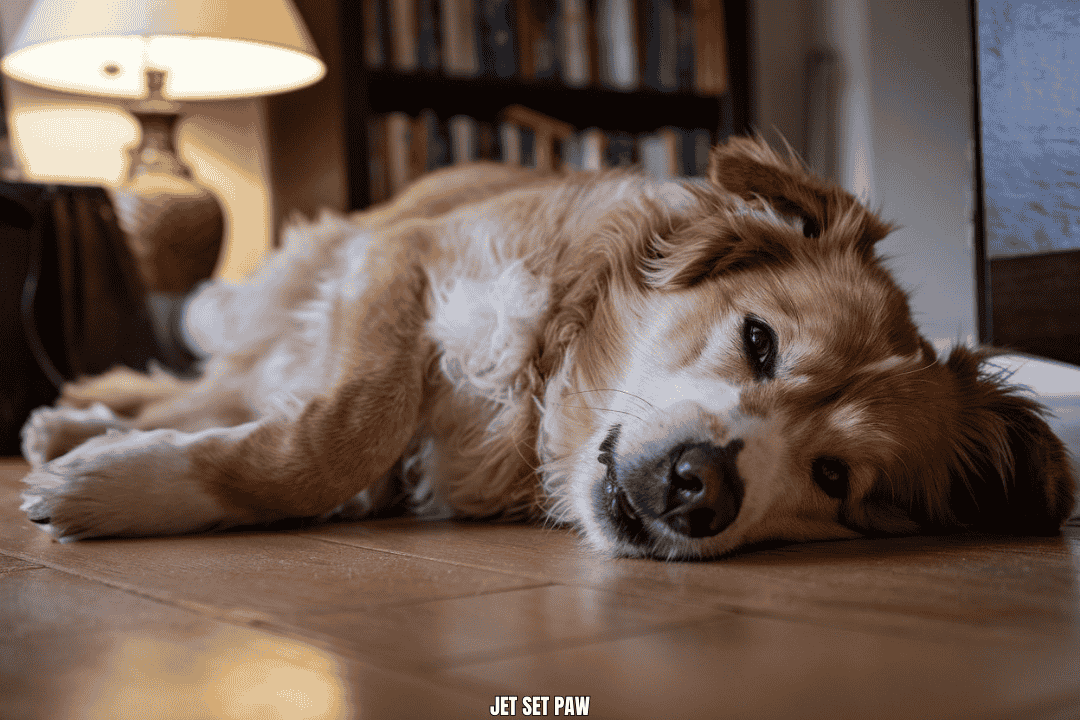
It was somewhere around 2 a.m. when I noticed it. My adventurous German Shepherd, Catch-him, was sprawled across his favorite corner of the bedroom floor, deep in what should have been an unremarkable sleep — except his chest was moving far too fast.
Rapid, shallow, almost frantic. I sat up. I watched. I counted. And then, because I am a pet parent with a smartphone and zero chill at 2 a.m., I Googled: why is my dog breathing so fast while sleeping?
My tricolor companion Nick, curled at the foot of the bed, was completely unbothered — slow, steady, the picture of canine peace. Catch-him, meanwhile, looked like he was running a marathon behind his closed eyes.
If you’ve ever found yourself in that same position — blanket half-off, phone screen too bright, watching your dog’s ribcage and silently bargaining with the universe — you already know the particular anxiety of not knowing whether what you’re seeing is perfectly normal or the beginning of something serious.
Here’s what I’ve learned since that night, after going deep into canine sleep science and speaking with veterinary professionals: most of the time, a dog breathing fast during sleep is a completely benign biological event.
But most of the time is not all of the time — and knowing the difference is exactly what this article is here to help you do.
Jet Set Paw: The Quick Verdict
Short on time? Here’s what you need to know right now:
- Fast breathing during sleep is usually normal. Dogs cycle through REM sleep frequently, and during active dream states, breathing naturally accelerates as the brain drives involuntary autonomic responses.
- The normal respiratory rate for a dog sleeping is 8–20 breaths per minute. Brief spikes above this during REM are expected and self-resolving.
- The REM connection is real. Rapid breathing, twitching paws, and soft vocalizations during sleep are all signs of an actively dreaming dog — not a dog in distress.
- If your dog is breathing fast while resting but acting completely normal when awake, a single isolated episode is rarely a cause for emergency alarm — but it warrants monitoring and a logged resting respiratory rate.
- Call your vet if: fast breathing persists beyond sleep, occurs alongside pale or blue gums, or your dog cannot settle comfortably into a normal resting position.
What Your Dog’s Sleeping Body Is Actually Doing — The Physiology Behind Every Breath
Before alarm sets in, it helps to understand what is actually happening inside your dog’s body during sleep — because the biology alone explains a remarkable amount of what pet owners observe and misread as cause for concern.
Dogs experience two primary sleep stages: Non-Rapid Eye Movement (NREM) sleep, a transitional phase of light to moderate rest where the body begins to slow, and Rapid Eye Movement (REM) sleep, the deep, neurologically active stage associated with dreaming.
During REM, the brainstem — specifically the pons and medulla oblongata — continues to regulate autonomic functions including respiration, but does so in direct response to the dreaming brain’s activity.
When a dog is processing a vivid dream sequence, the respiratory control centers receive escalating neural input, producing the rapid, irregular breathing pattern that so many owners find startling at 2 a.m.
This is not a malfunction. This is the system working exactly as designed.
What makes dogs distinctly different from humans in this context is their sleep architecture. Unlike people, who move through long, consolidated sleep cycles of roughly 90 minutes, dogs cycle in and out of REM far more frequently — sometimes completing a full cycle in as little as 20 minutes.
This means observable episodes of fast breathing, twitching, and vocalization occur more often across a single night’s sleep, making the behavior more visible and, understandably, more worrying to owners who aren’t expecting it.
Under normal conditions, a healthy dog’s resting respiratory rate during sleep sits between 8 and 20 breaths per minute. Giant breeds such as Great Danes and Saint Bernards, and brachycephalic breeds such as Bulldogs and Pugs, may hover toward the upper end of that range as an anatomical baseline — not a symptom.
The critical distinction this article will return to repeatedly is the difference between physiological tachypnea — fast breathing driven by normal biological processes like dreaming, thermoregulation, or exercise recovery — and pathological tachypnea, where an elevated respiratory rate signals underlying disease. One resolves on its own. The other does not.
| Metric | Normal Range | Concern Threshold |
|---|---|---|
| Resting respiratory rate | 8–20 breaths/min | >30 breaths/min at rest |
| REM-phase breathing | May spike briefly | Sustained, not self-resolving |
| Heart rate during sleep | 60–140 bpm (breed-dependent) | Arrhythmia or visible chest wall retractions |
| Recovery after waking | Normalizes within 60 seconds | Does not normalize; dog appears distressed |
REM Dreams, Muscle Twitches, and the “Sleep Running” Spectacle — When Fast Breathing Is Pure Biology
If you’ve ever watched your dog’s paws paddle against the floor, heard a muffled bark escape a closed mouth, or noticed their eyes flickering beneath their lids — you’ve witnessed the limbic system at full volume.
During REM sleep, the brain’s emotional and memory-processing center generates a cascade of motor and autonomic outputs entirely without the dog’s conscious participation.
Accelerated respiration, vocalization, facial twitching, and those unmistakable running-in-place leg movements are all part of the same neurological event. Your dog isn’t struggling. Your dog is, in all likelihood, chasing something magnificent.
What makes this possible — and what makes it look so dramatic — is the paradox at the heart of REM physiology. During this stage, the brainstem initiates REM atonia: a temporary suppression of voluntary muscle movement mediated by glycinergic inhibition of motor neurons.
This is the mechanism that prevents dogs (and humans) from physically acting out their dreams. However, this inhibition is selective.
It quiets the skeletal muscles responsible for intentional movement but does not suppress the autonomic nervous system — which means respiratory rate, heart rate, and yes, the small involuntary twitches of facial muscles and extremities, continue unimpeded.
Fast breathing and limb movement co-occur precisely because they respond to different neural masters.
For large-breed dogs — German Shepherds like Catch-him, Labrador Retrievers, Golden Retrievers — dog sleeping breathing heavy during REM is particularly pronounced.
Greater thoracic volume means greater diaphragmatic excursion with each breath, producing audible, visibly dramatic respiratory movement that in a smaller dog might go entirely unnoticed.
Brachycephalic breeds present their own variation. English Bulldogs, Pugs, and French Bulldogs produce more audible sleep sounds — snoring, snuffling, and accelerated breathing — due to the anatomical compression of their upper airways: stenotic nares, elongated soft palates, and a relatively narrow nasopharynx.
In most cases, this is structural, not an acute crisis. It does, however, mean brachycephalic owners should establish a clear personal baseline for their individual dog’s normal sleep sounds, so genuine deviation is recognizable.
How to Tell Dream-Breathing from Distress Breathing in Real Time
The single most useful skill any dog owner can develop is the ability to distinguish these two patterns in the moment:
Dream-breathing is irregular in rhythm, occurs within a defined episode of visible REM activity (twitching, eye movement, vocalization), and — most critically — resolves on its own. When the dog wakes, they reorient quickly: they look around, recognize their surroundings, and return to a normal resting state within seconds.
Distressed breathing does not resolve with waking. It persists across the sleep-to-wakefulness transition, is often accompanied by restlessness, an inability to settle, postural changes such as sitting upright or extending the neck, and, in more serious cases, open-mouth breathing at rest.
That last sign, in particular, is never normal in a resting dog and warrants immediate attention.
The Line Between Quirky and Critical — Medical Causes of Abnormal Rapid Breathing During Sleep
Most of the time, a dog breathing fast during sleep is biology doing its job. But the responsible reality of pet ownership means holding space for the other possibility — that the same symptom, in a different context or pattern, is the body’s earliest available signal that something systemic is wrong.
The behavior looks identical on the surface. The cause is what separates a dreaming dog from one that needs a veterinarian.
These are the medical differentials every dog owner should know by name.
Congestive Heart Failure (CHF) is among the most critical conditions to recognize early. The classic signs of congestive heart failure in dogs include a resting respiratory rate that consistently exceeds 30 breaths per minute across both sleep and waking hours, orthopnea — the inability to lie flat comfortably, often seen as a dog who repeatedly repositions or props their sternum upright — exercise intolerance, and a soft, productive-sounding cough that frequently presents immediately after rest.
On veterinary auscultation, bilateral pulmonary edema may be detected as fluid accumulation in the lung fields. CHF is manageable when caught early; pimobendan, furosemide, and enalapril form the cornerstone of medical management that meaningfully extends both lifespan and quality of life.
Brachycephalic Obstructive Airway Syndrome (BOAS) is the structural reality of flat-faced breeds. Stenotic nares, an elongated soft palate, and a hypoplastic trachea create chronic upper airway resistance that intensifies during sleep, manifesting as a dog sleeping, breathing heavily, and episodically hyperventilating while sleeping — particularly in warmer environments or after physical activity.
Unlike CHF, this is anatomical rather than acquired, but surgical intervention options exist and should be discussed with a veterinary specialist early in the dog’s life.
Laryngeal paralysis presents as progressive inspiratory stridor — a high-pitched, strained sound on inhalation — and is disproportionately common in geriatric Labrador Retrievers and Golden Retrievers.
As the arytenoid cartilages lose innervation and fail to abduct properly during breathing, airway resistance increases, and sleep becomes a period of labored respiratory effort rather than rest.
Pleural effusion — fluid accumulation within the pleural space — compresses lung expansion and produces fast, shallow, restrictive breathing that may initially appear only during rest before progressing to visible respiratory distress at all activity levels.
Anemia, regardless of underlying cause, reduces the oxygen-carrying capacity of erythrocytes, forcing the respiratory system to compensate through an increased rate. A dog with subclinical anemia may appear energetic and engaged during the day while their resting respiratory rate tells a quieter, more urgent story overnight.
Pain and fever both drive autonomic respiratory acceleration through independent pathways — nociceptive stimulation and hypothalamic thermoregulatory response, respectively — and can elevate breathing rate during sleep without producing obvious behavioral distress during waking hours.
This last point deserves emphasis: a dog breathing fast while resting but acting normal during the day is not automatically a dog that is fine. Early-stage CHF and subclinical anemia are both conditions where daytime presentation remains deceptively unremarkable.
Normal waking behavior does not rule out emerging pathology. The breathing pattern during rest is often the first honest data point available.
The Resting Respiratory Rate (RRR) Log — Your Most Useful Home Monitoring Tool
Counting your dog’s resting respiratory rate costs nothing and takes sixty seconds. With your dog lying still in a calm lateral recumbent position — not mid-REM, not post-exercise — count the number of complete breath cycles (one inhale plus one exhale equals one breath) over a full 60 seconds. Do not estimate. Count.
A single elevated reading is informative. A consistent RRR above 30 breaths per minute across three or more separate measurements is a clear signal to contact your veterinarian without delay.
For dogs with a confirmed cardiac diagnosis, daily RRR logging is not optional — it is the earliest available warning system for decompensation.
Many veterinary cardiologists consider a sustained RRR above 30 breaths per minute in a cardiac patient a same-day call, not a wait-and-see situation. Keep a dated log. Trends matter more than any single number.
Catch-Him at Midnight — A Story That Changed How I Watch My Dogs Sleep
I know what Catch-him’s REM breathing looks like. After years of sharing a bedroom with a German Shepherd who dreams with his whole body, I’ve become fluent in his sleep vocabulary — the paw flicks, the low rumbled bark that never quite makes it out, the brief acceleration of breath that comes and goes like a wave. I know how it starts and, more importantly, I know how it ends: with a long exhale, a shift of position, and stillness.
The night that changed things, it didn’t end that way.
It was late — past midnight — and I’d woken for no particular reason. Nick was at the foot of the bed, breathing in that slow, metronome-steady way he always does, the textbook picture of an unbothered dog in deep sleep.
Catch-him was on the floor beside me, and something about the sound of him made me sit up. His breathing was fast. Not the quick flutter of an active dream, but sustained — cycle after cycle without the usual resolution.
No twitching paws. No dream-vocalizations. Just fast, continuous, shallow breaths that had been going on long enough that I couldn’t tell you when they’d started.
I waited. I watched. I gave it two full minutes, which felt much longer than it sounds when you’re sitting in the dark counting your dog’s chest rises.
It didn’t slow down.
I turned on the lamp and did what I now know to do: I counted his resting respiratory rate properly — 60 seconds, eyes on his ribcage, finger tapping my knee.
Thirty-six breaths per minute. I checked his gums. Pink, moist, normal. I noted the time, noted the number, and called the clinic’s after-hours line.
The vet on call walked me through a checklist. No coughing. No postural changes. Gums normal. Catch-him had roused by then and was looking at me with the mild, affronted expression of a dog who has been woken up unnecessarily. His breathing, now that he was awake and upright, had normalized completely.
The vet’s assessment was measured: likely a prolonged autonomic episode during deep sleep, possibly compounded by the warm night. Not an emergency presentation. But she said something I’ve carried with me since: “The fact that you had a number to give me instead of just ‘fast’ — that’s what lets me help you.”
Catch-him was seen the following morning. His cardiac auscultation was clean, and his bloodwork was unremarkable. What that night gave me wasn’t a diagnosis — it was a habit.
Every Sunday morning, before the day gets complicated, I count both of their resting respiratory rates and write the numbers down.
Catch-him’s baseline runs between 18 and 22. Nick’s sits closer to 14. I know what normal looks like for each of them specifically, which means I’ll know immediately when it isn’t.
That’s the only version of “peace of mind” that actually holds up at midnight.
When “He’s Fine, Just Dreaming” Becomes the Wrong Answer — Red Flags That Demand Immediate Veterinary Attention
“Just dreaming” is one of the most common things pet owners tell themselves in the middle of the night — and most of the time, they’re right. But that reassurance has a threshold, and knowing exactly where that threshold sits is what separates an informed owner from one who waits too long.
The following signs are not ambiguous. They are not “monitor and see.” They are the specific clinical presentations that override self-reassurance entirely.
Cyanosis — a blue, grey, or purple discoloration of the gums, tongue, or inner lips — is a visible indicator of hypoxemia: dangerously low oxygen levels in the blood. Healthy gums are pink and moist. Any deviation toward blue or grey at rest is an emergency presentation, full stop.
Orthopnea is the inability to lie flat and remain comfortable. A dog that repeatedly repositions, props themselves upright on their sternum, or refuses lateral recumbency during rest is compensating for compromised respiratory capacity — one of the most consistent early signs of congestive heart failure in dogs.
Paradoxical breathing — where the chest and abdomen move in opposite directions rather than expanding together — signals severe respiratory compromise and upper airway obstruction or diaphragmatic dysfunction. This pattern is never normal.
Tripod posture — elbows abducted away from the body, neck extended forward, nostrils flaring — is the physical expression of air hunger. A dog assuming this posture is working hard for every breath and should not be made to wait.
Post-sleep disorientation, collapse, or syncope following a period of rapid breathing suggests possible hypoxia-related neurological involvement or cardiac arrhythmia and requires immediate evaluation.
Dog hyperventilating while sleeping that continues beyond 2–3 minutes after fully waking — with no return to a calm, settled respiratory pattern — is not a lingering dream. It is a symptom.
If you observe two or more of these signs simultaneously, this is not a wait-until-morning situation. Contact an emergency veterinary clinic immediately.
It bears repeating, because fear sometimes paralyzes action: early intervention changes outcomes.
Congestive heart failure caught before significant decompensation can be managed effectively with medications including pimobendan, furosemide, and enalapril — a protocol that has been shown to meaningfully extend both the length and quality of a dog’s life.
Calling your vet is not an overreaction. In the context of these signs, it is the most informed decision you can make.
The Sandy-Proof Sleep Health Checklist — What Every Dog Owner Should Know and Do
Know the Numbers:
- Normal resting respiratory rate: 8–20 breaths/min
- Concern threshold: >30 breaths/min across multiple measurements
- REM breathing spikes: expected, brief, and self-resolving
- Giant and brachycephalic breeds naturally trend toward the upper range
Watch for These:
- Blue, grey, or pale gums — emergency; do not wait
- Breathing fast during sleep and while fully awake — not normal
- Orthopnea, extended neck posture, elbows abducted — call the vet now
- Paradoxical chest and abdominal movement — severe respiratory compromise
- Post-sleep collapse, syncope, or disorientation — emergency presentation
- Hyperventilation that does not resolve within 2–3 minutes of waking
Do This Weekly:
- Count and log resting respiratory rate — 60 seconds, lateral recumbent, not mid-REM
- Know your individual dog’s personal baseline, not just the population average
- Note breed-specific context — brachycephalic dogs run audibly higher by anatomy
- Keep a dated written log — the trend across weeks reveals what a single night cannot
Remember Sandy’s Rule:
- Dream-breathing stops when they wake. Distressed breathing doesn’t.
- Acting normal during the day does not rule out early cardiac or respiratory disease
- A sustained RRR above 30 breaths/min is a phone call, not a wait-and-see
- One vet visit for peace of mind is always worth it
Catch-him still dreams loudly, and Nick still sleeps like he has no concerns whatsoever — and because I know both of their numbers, I can watch them both with something that actually resembles peace. That’s what informed watching gives you. It’s one of the quietest, most powerful things you can do for the animals who trust you completely.